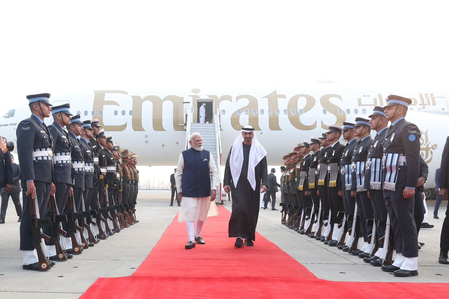
New Delhi, Feb 8 (IANS) India and the United Arab Emirates (UAE) are steadily transforming their bilateral relationship into a clearly defined defence and security framework, reflecting a shift from primarily transactional engagements to cooperation that also addresses hard-security calculations, according to a report.
“This happened following the conclusion of the Strategic Defence Partnership Agreement between the two nations in January 2026. This agreement was part of the wider package of agreements, including defence, space, energy, technology, and investment. The defence partnership sits within a broader institutional deepening of the ‘Comprehensive Strategic Partnership’,” wrote Dr Anu Sharma, Assistant Professor at Amity Institute of Defence and Strategic Studies (AIDSS), in an opinion piece for India Narrative.
According to Sharma, the proposed Strategic Defence Partnership framework is designed to broaden cooperation across multiple domains, including defence industrial collaboration, innovation and advanced technologies, training and education, doctrine development, special operations, interoperability, cyberspace and counter-terrorism.
The framework also indicates a transition from occasional military interactions toward a more structured partnership through the alignment of doctrines, enhanced interoperability and capacity-building in emerging sectors such as cybersecurity. The timing of this development also reflects evolving geopolitical tensions in West Asia, highlighting shifting regional alignments and increasing strategic complexities, the opinion piece in India Narrative noted.
The report further explained that for the UAE, the past decade has underscored the importance of diversifying partnerships that enhance military capabilities, intelligence-sharing and access to advanced technologies.
For India, instability in West Asia directly affects energy price stability, the welfare of the Indian diaspora and maritime security, challenges that cannot be addressed through diplomacy alone.
Counter-terrorism cooperation and financial enforcement have also become integral components of the partnership. Both countries have reiterated condemnation of terrorism, including cross-border terrorism, and affirmed their commitment to strengthening cooperation under the Financial Action Task Force (FATF) framework to curb terror financing and reinforce anti-money laundering mechanisms.
The development, according to the report, reflects the partnership as a comprehensive security arrangement that spans both kinetic and non-kinetic domains, including intelligence coordination, financial monitoring and regulatory measures.
Another notable feature of the agreement is the integration of security cooperation with connectivity and corridor-based geopolitical strategies. The framework identifies India and the UAE as central partners in the India–Middle East–Europe Economic Corridor (IMEC) initiative and acknowledges their strong ties with Israel, indicating that India-UAE coordination carries wider regional strategic implications.
“The strategic idea is that if connectivity projects become more central to geopolitical competition, states seek security arrangements that protect infrastructure, shipping, data routes, and supply chains. Defence partnerships are thus fast becoming the ‘insurance layer’ of geoeconomic strategy,” Sharma wrote.
From India’s perspective, the defence partnership reflects a broader strategic shift from being largely an economic stakeholder in the Gulf region to playing a more direct role in regional security, particularly in maritime security and non-traditional threat domains.
The focus areas include trade corridors, connectivity for micro, small and medium enterprises, cybersecurity, interoperability and cross-domain threats such as drone warfare, cyberattacks, maritime risks and terror financing networks.
For the UAE, strengthening defence ties with India offers diversification in security and industrial cooperation. India provides a unique combination of a vast and rapidly expanding defence-industrial base, which the UAE views as an opportunity for co-developing military capabilities and establishing resilient supply chain partnerships.
The deeper geopolitical importance of the partnership lies in its ability to reshape regional strategic signalling. By emphasising sovereignty, strategic autonomy, counter-terror financing, interoperability, and collaboration in advanced technologies, India and the UAE are building a partnership structured to function effectively in a multipolar and crisis-prone regional environment rather than only during periods of stability.
“This is not an alliance in the classical sense, but it is a strategic alignment. It projects the pragmatic operational content — one that could increasingly shape how India positions itself in West Asia as a less distant partner focused on a security-relevant partnership with bilaterally established defence cooperation,” Sharma wrote.
According to her, the India-UAE strategic defence partnership represents a consolidation phase, formalising a security relationship that has gradually expanded beneath the surface of broad economic engagement.
The convergence across defence manufacturing, interoperability, cybersecurity, counter-terrorism and related sectors such as space and advanced technology demonstrates that both nations are strengthening resilient ties within an increasingly contested regional order where safeguarding trade routes, energy supply chains and critical infrastructure demands stronger defence coordination alongside diplomatic engagement.
–IASN
sd/