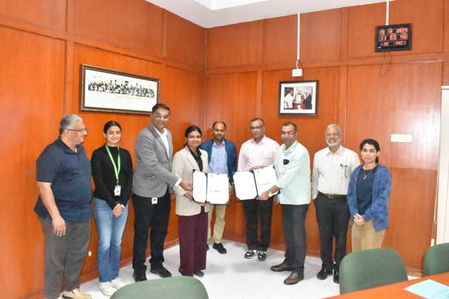
New Delhi, Jan 24 (IANS) The Jawaharlal Nehru Centre for Advanced Scientific Research (JNCASR), an autonomous institute of the Department of Science and Technology (DST), has signed a Memorandum of Understanding (MoU) with Bengaluru-based Dreamfly Innovations to develop advanced thermal materials for aviation batteries.
Under the collaboration, advanced thermal materials and thermoelectric devices will be developed for improving thermal management (storage and conversion) in aviation batteries.
The partnership will address current challenges through materials-level innovation and help translate fundamental materials research into robust, deployable thermal technologies for real-world aviation platforms.
“The joint effort combines JNCASR’s strengths in materials design, synthesis, advanced characterisation, and thermal transport measurements with Dreamfly Innovations’ expertise in aviation battery engineering and system-level integration,” the Ministry of Science and Technology said.
Effective heat management remains a major bottleneck for high-energy-density lithium-based batteries used in the aviation industry.
Excessive heat generation during high-power operation can compromise efficiency, reduce battery lifespan, and pose serious safety risks.
While passive thermal management strategies such as Phase Change Materials (PCMs) are attractive due to their low weight and zero power consumption, their widespread adoption has been limited by the inherently poor thermal conductivity of conventional PCMs.
As a result, heat generated by the battery is not absorbed rapidly enough, leading to temperature rise and accelerated degradation of battery components.
A common approach to overcome this limitation involves incorporating high-thermal-conductivity additives to form composite PCMs.
However, such composites often suffer from long-term stability issues, including additive agglomeration during repeated thermal cycling, which ultimately degrades performance and reliability.
“The advanced thermal materials will be engineered for high thermal conductivity to rapidly absorb excess heat during high-load operation, maintain battery temperatures within optimal operating windows, and enable lightweight, thermal regulation without compromising long-term stability,” the Ministry said.
The collaboration brings together academic research expertise from Prof. Kanishka Biswas’ lab in JNCASR and industrial innovation in Dreamfly to address critical challenges in drone performance, safety, and operational endurance, it added.
–IANS
rvt/