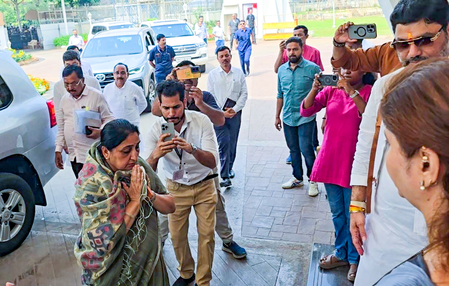
Mumbai, Jan 31 (IANS) The Nationalist Congress Party’s decision to pass the mantle to former Maharashtra deputy chief minister late Ajit Pawar after his death in a plane crash aimed to ensure the continuation of dynastic succession in yet another regional party.
NCP, which is yet to recover from the deep shock of the sudden and untimely death of Ajit Pawar, preferred to appoint Sunetra Pawar as the legislature party leader and DCM in a bid to ride on Pawar’s legacy.
The party arrived at a decision not to give mantel to any other leader to avoid a supremacy war amid ongoing debate over the merger between the two NCP factions.
In Maharashtra’s regional politics, the leadership of the Shiv Sena passed from Balasaheb Thackeray to Uddhav Thackeray. Today, the father-son duo of Uddhav and Aaditya Thackeray makes the party’s strategic decisions. In the Eknath Shinde faction of the Shiv Sena, the Deputy Chief Minister’s son, Dr Shrikant Shinde, handles major responsibilities. Similarly, in the MNS, Amit Thackeray is emerging as the successor to Raj Thackeray.
In the formerly united NCP, Sharad Pawar’s nephew Ajit Pawar and daughter Supriya Sule managed party affairs. It was Sharad Pawar’s attempt to project Supriya as his political heir that led to Ajit Pawar’s rebellion.
In Ajit Pawar’s faction of the NCP, his wife, Sunetra Pawar, has now been appointed Deputy Chief Minister. There is ongoing curiosity regarding whether his sons, Parth and Jay Pawar, will assume any official posts.
The Congress party’s policy to overlooking local issues, combined with the growing intensity of regional identity, led to the emergence of regional parties across India. While these parties achieved significant success, they also became deeply rooted in dynastic politics. NCP too has decided to go on the same line.
The Congress party has a long-standing tradition of dynastic rule, featuring a prominent list: Pandit Nehru, Indira Gandhi, Sanjay Gandhi, Rajiv Gandhi, Sonia Gandhi, Rahul Gandhi, and Priyanka Gandhi.
In contrast, the BJP has not yet seen dynastic rule at the national leadership level. Although the new party president, Nitin Nabin, is the son of a BJP leader from Bihar, he entered politics only after his father’s passing. While dynastic trends are becoming visible in the BJP’s second-tier leadership, they are not as pervasive as in Congress.
As far as Tamil Nadu is concerned, in the DMK, the tradition flows from Karunanidhi to his son and Chief Minister M.K. Stalin, and now to his grandson, Deputy CM Udhayanidhi Stalin. Additionally, Karunanidhi’s daughter Kanimozhi is an MP, and his other son, Alagiri, served as a Union Minister.
In Punjab, the father-son duo of Parkash Singh Badal and Sukhbir Singh Badal dominated the Akali Dal, with Sukhbir’s wife also serving as an MP. In Haryana, the Lok Dal saw several generations of the Devi Lal family, including Om Prakash, Abhay, Ajay, and Dushyant Chautala, active in politics.
In Odisha, after Biju Patnaik, his son Naveen Patnaik served as Chief Minister for decades. In Andhra Pradesh, N. Chandrababu Naidu seized power from his father-in-law, N.T. Rama Rao in the TDP. Naidu’s son, Nara Lokesh, is currently a minister. In Telangana’s BRS, K. Chandrashekar Rao, his son K.T. Rama Rao, nephew Harish Rao, and daughter K. Kavitha held various high offices.
In Jammu & Kashmir, three generations of the Abdullah family (Sheikh, Farooq, and Omar) have served as Chief Ministers through the National Conference. Similarly, in the PDP, Mufti Mohammad Sayeed and his daughter, Mehbooba Mufti, both held the post of Chief Minister.
In Bihar, the RJD traces its lineage to Lalu Prasad Yadav, Rabri Devi, and Tejashwi Yadav. In Uttar Pradesh, the Samajwadi Party, led by Mulayam Singh Yadav’s son, Akhilesh, a former CM, has his daughter-in-law and brothers holding, or having held, parliamentary and ministerial positions.
In West Bengal, Mamata Banerjee has positioned her nephew, Abhishek Banerjee, as her successor. In Karnataka, H.D. Deve Gowda’s JD(S) boasts a long list of family members in power, including his sons H.D. Kumaraswamy and Revanna, as well as his grandsons and daughters-in-law.
Even the Left parties, despite their public criticism of dynastic politics, are not entirely immune; in Kerala, Chief Minister Pinarayi Vijayan’s son-in-law, Mohamed Riyas, serves as a minister in his cabinet.
(Sanjay Jog can be contacted at sanjay.j@ians.in)
–IANS
sj/dan