
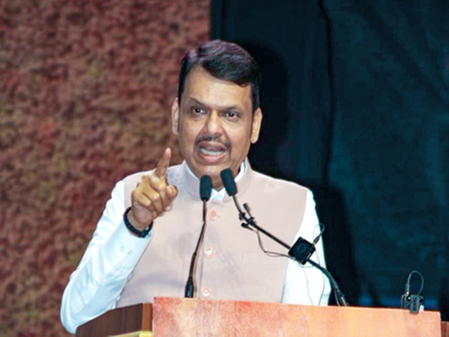
Mumbai, May 14 (IANS) In a major move to boost skill-based education and regional development, Maharashtra Chief Minister Devendra Fadnavis has approved 17 new professional colleges in tribal, hilly and backward districts of the state.
The decision was taken during a meeting of the Maharashtra State Higher Education and Development Commission (MAHED) chaired by the Chief Minister.
According to an official release, priority approval has been granted for 17 new colleges specialising in Engineering, Architecture, Hotel Management and Catering Technology (HMCT) and B.Voc courses across seven identified districts.
Fadnavis said education must evolve in line with changing industrial requirements and emerging employment opportunities.
To ensure balanced regional growth, the government is prioritising the establishment of professional institutions in Gadchiroli, Nandurbar, Hingoli, Washim, Dharashiv, Sindhudurg and Parbhani districts.
The state government has also decided that no new B.Pharmacy or D.Pharmacy institutions will be permitted until the academic year 2030-31.
The release stated that emphasis is being laid on updating the education system to align with industrial needs and modern technological advancements.
New skill development centres have also been sanctioned to bridge the gap between “human capital” and “talent capital”, it added.
According to the release, Engineering and B.Voc colleges will be established across all seven priority districts.
Architecture colleges will be prioritised in Dharashiv and Parbhani, while HMCT institutes are planned for Nandurbar and Sindhudurg.
The Chief Minister highlighted the integration of the National Education Policy (NEP), with a focus on multidisciplinary learning.
He directed traditional colleges to introduce Social Work as an independent faculty to broaden students’ skill sets.
“We are focusing on making our youth employment-ready by developing new curricula that meet the demands of modern industry. Through the Ratan Tata Maharashtra State Skill University, over 61,000 students have already been trained in industry-friendly skills,” Fadnavis said.
Approval was also granted to the master plan of Dr Babasaheb Ambedkar Technological University (BATU) for the 2025-2031 period.
The university has been directed to partner with industries for research and advanced laboratories, modernise its curriculum to match industry standards and limit intake capacity to maintain educational quality.
Further, to prevent over-saturation and ensure quality control, the state government has decided not to permit new pharmacy colleges or allow an increase in intake capacity in existing institutions from the academic year 2027-28 to 2030-31.
The directive will be formally communicated to the Central Government and the Pharmacy Council of India (PCI), the release added.
–IANS
sj/pgh