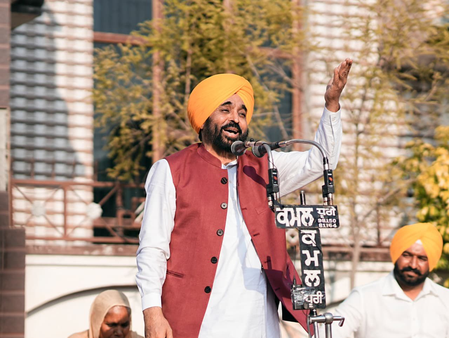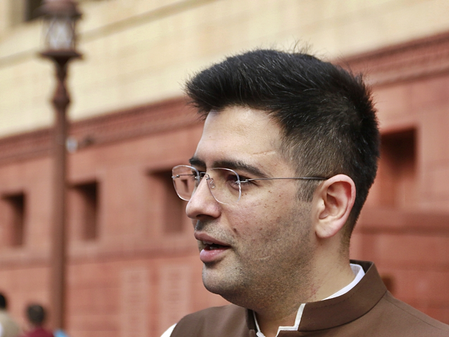
New Delhi, Dec 3 (IANS) “Guru Nanak Dev Ji taught us that wind is the Guru, water is the father, and the earth is the mother. I come from Punjab, also known as the land of five rivers. In fact, if you look at the name of Punjab — Panj plus Aab — it means five (panj) and aab (water, rivers). Punjab, a state with five rivers, is today facing the biggest challenges regarding water quality and quantity,” Raghav Chadha of the Aam Aadmi Party from Punjab said on Wednesday.
He was speaking on the “Statutory Resolution” moved by Union Minister Bhupender Yadav under Article 252(1) of the Constitution, that the Water (Prevention and Control of Pollution) Amendment Act, 2024 (which decriminalises minor offences) be adopted for the state of Manipur, where President’s Rule under Article 356 has been in force since 13th February, 2025, so that the Amendment Act shall apply to Manipur with effect from the date of this resolution.
“I would like my voice to reach the Minister through you. When the country needed food, Punjab launched the Green Revolution. When India was battling hunger, Punjab provided food to the nation. When the country needed a hero, Punjab became a hero. But today, that same hero is paying a heavy price. When the country faced a food shortage, Punjab fed the nation. Consequently, farmers used chemical fertilizers and pesticides, cultivated water-intensive crops like rice, and drew water from tube wells. As a result, Punjab’s water became toxic and the water table plummeted. This is not the fault of farmers, but the price of serving the nation,” Chadha asserted in the Upper House.
The biggest problem is toxic water, he said.
“The Government of India’s 2025 Groundwater Quality Report shows that Punjab has the highest uranium pollution. Uranium is not a simple metal, but a radioactive heavy metal that causes kidney damage, cancer, weakened bones, and disability in future generations. 62.5 per cent of post-monsoon groundwater samples were found to be above safe limits. Metals like arsenic, lead, cadmium, and chromium also exceed WHO limits, especially in the Malwa region — Bhatinda, Mansa, Faridkot, Sangrur, Sri Mukhsar Sahib, and Fazilka,” he pointed out.
Raising an alarm on water toxicity, the Parliamentarian said: “Train No. 14703, which runs from Bhatinda to Bikaner, is called the ‘Cancer Train’ because it carries cancer patients seeking treatment, not pilgrims.”
He added: “The second problem is groundwater depletion. It takes 5,000 liters of water to produce one kilogram of rice. Rice isn’t the diet of Punjabis, but farmers sow paddy to feed the nation. As a result, 113 out of 117 blocks are over-exploited. In 1970, the average water table was 20 feet; today, it has reached 500 feet. NASA’s GRACE satellite shows that Punjab is the world’s fastest-losing region.”
Pointing to the third problem, he said: “The third problem is the dying of rivers. Rivers like the Sutlej, Beas, and Ghaggar are polluted by industrial waste, chemicals, pharmaceutical waste, and untreated sewage. CPCB data shows that 76 per cent of Punjab’s river streams are among the most polluted in the country.”
Drawing the nation’s attention, Chadha said: “Today, Punjab seeks the central government’s help. This is not charity, but a demand for justice. If Punjab has been the backbone of the nation’s food security for 50 years, then today the nation should support Punjab.”
He concluded with suggestions: “Launch the Punjab Water Restoration Mission, implement 24×7 digital monitoring of industrial discharges, introduce modern ecological engineering to revive rivers, ensure universal access to safe drinking water, and conduct independent foreign audits.”
–IANS
sktr/pgh