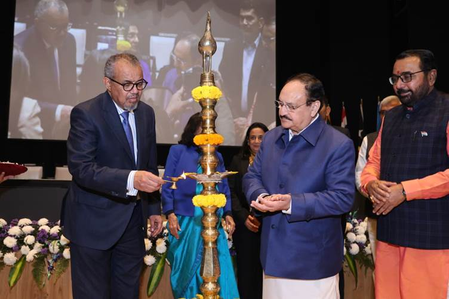
New Delhi, Dec 20 (IANS) The new WHO -South East Asia Regional Office (SEARO) building is a testament to collective commitment to global health, said Union Minister for Health and Family Welfare JP Nadda.
The new building was jointly inaugurated by Prime Minister Narendra Modi and Dr. Tedros Adhanom Ghebreyesus, Director-General of the World Health Organization (WHO) at the concluding ceremony of the second WHO Global Summit on Traditional Medicine at the Bharat Mandapam here.
Visiting the building, Nadda highlighted India’s unwavering commitment to strengthening regional and global health cooperation. Emphasising the importance of collective action, he underlined that shared public health challenges require collaborative, coordinated, and sustained efforts among nations.
“The WHO SEARO building is not merely a physical structure but a powerful symbol of shared aspirations and collective resolve of the people of the South-East Asia Region,” the Union Health Minister said.
He stated that the facility reflects the spirit of partnership and solidarity in advancing the cause of public health and well-being, serving nearly half a billion people across the region.
Speaking on the occasion, the WHO Director-General described the WHO SEARO building as a strong symbol of shared purpose and collective commitment to serving humanity.
“The new facility stands as a testament to the enduring and trusted partnership between the World Health Organization and the Government of India in advancing public health at both regional and global levels,” Dr. Tedros added.
Speaking at the Summit, the WHO chief lauded India’s role in elevating traditional medicine in the global health agenda.
“From the establishment of a dedicated Ministry of Ayush, to the creation of the WHO Global Traditional Medicine Centre in Jamnagar, India has shown that tradition and innovation, heritage and science can advance together. Through its centuries-old Ayush systems, India has shown the world that traditional wisdom and modern science are not inconsistent, but complementary,” Tedros said.
He added that traditional medicine can help to address many of the threats to health of our modern world: the growing burden of noncommunicable diseases; inequitable access to health services; and climate change.
–IANS
rvt/