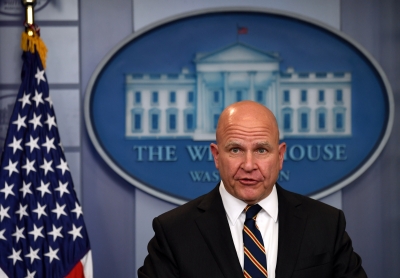
Washington, April 22 (IANS) Raising serious doubts over Pakistan’s offer to broker talks between the United States and Iran, former US National Security Advisor (NSA) H R McMaster on Wednesday accused Islamabad of pursuing a dual-track approach in security cooperation while asserting that the country should certainly be considered as a client of the Chinese Communist Party (CCP).
“I think what you have to do is consider Pakistan as certainly a client of the Chinese Communist Party,” McMaster told IANS in an exclusive interview when asked about the role of Pakistan in mediating between the US and Iran.
In a wide-ranging conversation, McMaster offers a candid assessment of the shifting global order, touching on Iran, China, Pakistan, and the trajectory of US-India ties. He also speaks bluntly on Pakistan’s credibility, describes US-India relations as “rocky” but essential, the Chinese challenge, and warns of growing vulnerabilities around energy security and geopolitical alignments.
Excerpts:
IANS: There is this whole talk about the Iran War and the negotiation that’s being done through Pakistan. In India, a lot of people believe that Pakistan cannot be a trusted partner because of the experience that we have with terrorism coming from across the border, and the US has also seen that. How do you see it in the entire context? Can Pakistan be trusted?
McMaster: I think what you have to do is consider Pakistan as certainly a client of the Chinese Communist Party. And I think that compromises them in this connection because the Chinese Communist Party, I’m sure, is desperate to keep the Islamic Republic, the theocratic dictatorship in power in Iran. So I think that there is probably an ulterior motive here in offering their good offices to broker these talks. My experience with the Pakistani army has been one of great disappointment, and my recognition over time that Pakistan often offers to be your friend and to assist, for example, in counter-terrorism efforts against Al-Qaeda or against the Taliban and the Haqqani network, while at the same time they’re supporting your enemies. So I, I have and of course, as India knows well so well they’ve been using terrorist organisations as an arm of their foreign policy since the late 1940s.
IANS: How do you see the energy crisis in its broader context, given that India’s imports also come from the Middle East?
McMaster: Well, this is very similar to the energy crisis associated with Russia’s massive invasion of Ukraine in February of 2022. So I think, it highlights the need for energy security. I think that the US partnership with India is immensely important on so many levels, but I think one of the most important dimensions of that relationship should be a partnership, a partnership with other countries as well to develop technologies and apply technologies that will allow for a much higher degree of energy security, while also taking on the other challenges that India faces in the area of water security and food security. I see these as all interconnected, and I see tremendous opportunities for the United States to work with India on a broad range of energy solutions including, for example access to US Liquified Natural Gas exports, diversifying their sources of energy with maybe procuring more from the US who is now the world’s largest producer of fossil fuels, but also renewable solutions that are not reliant on supply chains controlled by China. These are wind turbines and solar panels, for example. And in the future, you have nuclear technologies that hold great promise, such as small modular reactors or EM squared reactors.
IANS: You have been a big advocate of the relationship between the two largest democratic countries in the world. How has it evolved in the second term?
McMaster: It’s been rocky, I’ll say that. You know, it’s been rocky, and it didn’t need to be that rocky in my view. And so I, think that, it was unfortunate the tensions in the relationship that became apparent when President Trump felt as if he was, didn’t receive enough credit for reducing tensions on the border between India and Pakistan and the latest conflict. But then also, the trade issues have always been kind of sticky. But we could work together on those. We need each other… I think what we need is something in the middle by assuring our Indian partners, that you know, that the US, I think, from India’s perspective, should be the most important partner for India going forward… The US and India are the solution to each other’s problems in many ways, in terms of the threat from Chinese aggression. We have to remember, it wasn’t that long ago that Chinese soldiers were attacking Indian soldiers on the Himalayan frontier. And China is still employing a whole range of subversive actions and forms of economic aggression that the US and India and the other of the world’s largest economies Japan the EU, we should all be working together on common problems and challenges.
IANS: President Trump is scheduled to travel to China in less than a month. How do you see the US China relationship in that context?
McMaster: Well, you know, I think what you could get is a temporary reprieve, a temporary pause in trade-related and economic-related tensions. But it’s not gonna be much more than that because of the nature of the Chinese Communist Party, the ideology that drives and constrains its leaders, and the nature of its status mercantilist economic system that is fundamentally incompatible with our free market economies. So, I see this as maybe a temporary reprieve in tensions, but the gravity or the weight, behind those fundamental differences will continue to bear out. What’s really important will be the outcome in the Middle East. I think, what China has done is support Iran with purchases of their oil. They buy 90 per cent of Iran’s oil to feed the Iranian regime’s ATM, and they use that cash to support terrorists across the region. And as we’ve seen to build up a massive missile, drone strike complex, which they have unleashed against 14 countries across the Middle East. And so, China has been the main client for the Iranians. If the Iranian regime was to have a fundamental change, a fundamental change such that it ceases its permanent hostility to the United States, Israel, and its Arab neighbors, China is a big loser in the Middle East. And I think what happens is, China is much less likely to engage in aggression in the Indo-Pacific region. That’s why I think India, all countries who want peace and security in the Indo-Pacific region and beyond should be in favor of really ending the Islamic Republic as we have known it, as it waged, really. I mean, we have to acknowledge, I mean, they have been waging a proxy war against the United States, Israel, and their Arab neighbours for 47 years.
IANS: Where do you see this war heading towards now from here?
McMaster: I do not think that the Islamic Republic of Iran can sustain itself. I think it’s unsustainable not only in connection with the damage that has been done to its military, to its ability to project power outside of its borders, but the damage that it has done to itself and its own people through corruption, through prioritizing a nuclear weapons program and its missile programs over the welfare of its own people, and the waste of hundreds of billions of dollars on the nuclear missile programs, the corruption of the regime, ..or collectives associated with the regime that are extracting money and sending it abroad. We know, for example, that the new supreme leader, has tens of millions of dollars in offshore accounts. So I think the corruption of the regime, and especially I would say the most recent brutality that we’ve seen with them, not only in the executions that they continue to commit against political prisoners but also the mass murder, of what appears to be 40,000 people in a 48 hour period in January. So I think the humanitarian stakes are very high. The geopolitical stakes are very high. But the stakes are highest for the Iranian people, and I would like to see more focus on them, and, the need to really continue actions, whether they’re financial or military to weaken the repressive arms of the theocratic dictatorship.
IANS: Given the improvement in US-China and US-Pakistan relations, what impact do you think it’ll have on India-US ties?
McMaster: I think the trajectory for US-India relations is very good, very good for, because if you look at kind of just the structural issues from a geopolitical perspective, you have two …powers on the Eurasian landmass of China and Russia. And I understand why India continues to hedge with Russia because they have these two … powers, on India’s borders or in the region. And those, the China and Russia have pulled into their orbit the only hereditary communist dictatorship in the world, in North Korea the theocratic dictatorship in Iran, they did have the Maduro regime in Venezuela under their wing. So I see this as a competition between our free and open societies, India and the United States being the world’s two largest democracies, and our free market economic systems. India and the United States are natural partners. I have great confidence in the relationship. I also have great confidence in the relationship because of the incredibly talented and vibrant Indian diaspora that we have benefited from in the United States. Some of our most creative entrepreneurs, in the US are Indian American citizens. So I think among that generation and the younger generations, we also have just the strongest cultural ties and actually familial ties that are foundational to our relationship.
IANS: In what way can India and US improve their defence corporation?
McMaster: There’s a near-term obstacle, and that near-term obstacle is the Indian military’s relationship with the Russian military. And so because of security concerns, there is a great deal of reluctance to sell the most capable US weapons, the most capable US ammunition, because of the threat of compromise. We have to get over that somehow. One way to do that would be for India to slowly reduce their reliance on Russian munitions and weapons. Of course they’re not available because they don’t have the industrial capacity to sustain their onslaught against the Ukrainian people. But also it doesn’t work. Their air defence systems are easy to defeat. And so I think it’s important for India to slowly, or as quickly as they can, reduce reliance on Russian weapon systems. You could do that with third country weapon systems, from buying European systems and so forth. But of course, the US equipment, I think is, is what is most capable at defeating what I think India has to be concerned about, which are Chinese weapon systems. Chinese radar systems, Chinese fighter aircraft and, and other technologies including electromagnetic warfare and so forth that China is providing to Pakistan.
IANS: What’s your thought on President Trump’s foreign policy and national security because you have worked with him in the past?
McMaster: Well, I’ll tell you, I have confidence that over time we will have stronger relationships, stronger alliances, and partnerships. What I had been disappointed in is as much of the rhetoric, at times unserious and at times bombastic and offensive public diplomacy and, and communications. It is self-defeating in my view… So in the long term, what we could have, I think, is stronger alliances because President Trump has been successful in convincing European nations, for example, to invest more in their defence. And now what we have to do is build up what has become a trust deficit associated with some of the language that our European friends, our Indian friends have found offensive. But, you know, of course, it’s important to remind people, that the United States is not a monarchy. We fought our, our revolution 250 years ago, to based on this radical idea that sovereignty lies with the people, not with the king, not even with the parliament. And so as your listeners and viewers will know, we are federal system and, and there is a great deal of affinity for India across the United States Congress, across the country in the United States. And ultimately, our government reflects that, despite how the president’s priorities, have generated some of these clashes that are, I think sadly, mainly rhetorical and not substantive, but all but still damaging to that kind of trust in the relationship.
IANS: As a former NSA and national security analyst and expert in America, how do you see Prime Minister Narendra Modi’s last 12 years as India has been placed in the global domain, on a global platform…
McMaster: Well, he’s an advocate for Indian interests, obviously. You know, he has spanned the United States and United States adversaries. At times I wish he had been a little bit less supportive of Vladimir Putin. But I would say the same thing at President Trump. I wish President Trump was less supportive of Vladimir Putin too. I know that he took strong action against Beijing and the Chinese Communist Party after witnessing the aggression against India, really the physical aggression, but also the aggression through the use of Chinese apps and, and Chinese efforts to, to gather data to wage a war of psychological war, a war of perception, on India with the shutdown of so many of the Chinese companies and Chinese apps. He’s been quite strong there, I think. And again, the weight of the gravity of our mutual interests will continue to pull us together. I had the great privilege of, of working with the leaders who were still in place, include Minister Jaishankar, my friend Ajit Doval, and, the Prime Minister a person with whom I have great respect. And we had, we had really wonderful conversations. He was a wonderful host to me soon after I became National Security Advisor. And of course, as you know, we prioritised and we had it explicitly in the national security strategy. It was published in 2017 that it was a positive for the world for India to succeed in all of its endeavours and, and to strengthen the partnership with India and amplify India’s voice, which can be quite strong in various fora that we’re not part of, whether it’s the BRICS format. I’m optimistic about the future of relationship. There have been disappointments on both sides in Delhi and in Washington. But I have great faith that we can get over all that again, based on the alignment of our interests, the alignment of our people our forms of government and, and our just affinity for one another, our natural affinity for one another.
–IANS
lkj/as