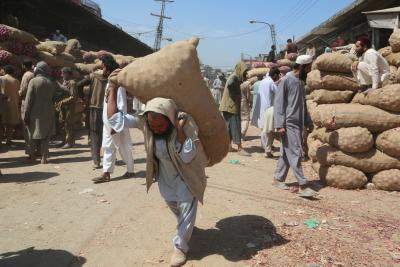
Islamabad, Jan 11 (IANS) A fresh increase in flour prices in Shangla and other upper districts of Pakistan’s Khyber Pakhtunkhwa has sparked concerns among residents, who have blamed weak government oversight, hoarding, and profiteering for the surge, local media reported.
The price of a 20-kilogram bag of flour has increased to (Pakistani) Rs 2,850 in Shangla and nearby areas, while a 40-kilogram bag is selling for up to Rs 5,700. A 50-kilogram bag is reportedly available at around Rs 7,000, making essential food supplies unaffordable for many low and middle-class homes, Pakistani daily The Nation reported.
Residents stated that the increasing price of flour has increased financial strain already caused by inflation and urged the provincial government and district administration to take immediate measures to implement price controls on essential commodities.
Earlier, illegal smuggling of flour from Punjab and other provinces into Afghanistan was blamed for the price surge in Khyber Pakhtunkhwa. However, residents and traders mentioned that the recent rise in prices of flour in the upper districts, despite the closure ofthe Afghanistan-Pakistan border, suggests that smuggling is no longer the reason behind the increased cost.
Economists and social observers warned that continued price rise could further increase poverty and food insecurity, and urged authorities to activate the price control committee and act against hoarders and profiteering networks.
Earlier this month, a report said that Pakistan’s economy has ceased to be about growth and has become one of survival as households in the country are forced to spend nearly two-thirds of their income on food and electricity. Citing the Pakistan Bureau of Statistics’ latest Household Integrated Economic Survey, it revealed that life in Pakistan has increasingly become a matter of basic survival.
“Food alone now absorbs more than a third of household spending. Another quarter goes into housing, electricity, and gas. Together, these basic needs consume 63 per cent of total expenditure. This is the direct result of prolonged inflation and policy choices that have steadily raised the cost of essentials. Incomes have risen on paper. They have not kept pace in reality. While average monthly earnings have increased over the past six years, household spending has risen faster. What families gain in nominal income is eroded by higher prices,” Pakistani daily The Express Tribune reported.
The report noted that the shrinking purchasing power of the Pakistani rupee is reflected in what households can no longer afford.
“Spending on education has dropped to just 2.5 per cent. It is now less than half the cost of housing and utilities. Health and recreation together make up barely a few percentage points. A society that cuts back on learning and well-being is paying for stability today by mortgaging its future,” it warned.
According to the report, this is not resilience, but fragility disguised as coping. Highlighting the steps to be taken, it said: “First, stabilising the cost of food and power must become an economic priority, not an afterthought. Second, inflation control must move beyond interest rates. Supply-side failures in food markets need fixing. And third, education and health spending need insulation from economic shocks. Household budgets are under siege.”
“If policy continues to treat survival as an acceptable equilibrium, the long-term costs will be far greater than today’s fiscal discomfort,” the report added.
–IANS
akl/vd