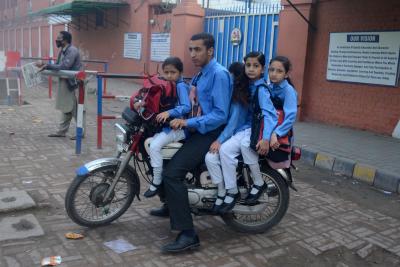
Islamabad, Feb 8 (IANS) Pakistan has been ranked last in South Asia’s literacy rating, as per recent data, and its education crisis has become its most severe economic vulnerability, according to a report in the Pakistani media.
“A Free and Fair Election Network report shows Pakistan has climbed to a 63 per cent literacy rate, which is a staggering 15 percentage points below the regional average of 78 per cent. In today’s competitive global economy, no nation can hope to thrive with an undereducated workforce. This is not just an education crisis, but arguably our most severe economic vulnerability,” an editorial in Pakistani daily The Express Tribune stated.
According to the report, Pakistan could get rid of terrorism tomorrow; however, it would still not be able to set up high-skilled industries, as every third person in the country is illiterate.
“We have suffered under authoritarian dictatorships, enlightened moderation, controlled democracy, crony capitalism and Islamic socialism, all promising successes that never came, because even though the exact reasons for failures in each case are unique, all failed to educate a workforce for future success,” the editorial said.
Earlier, a report revealed that about 28 per cent of school-age children in Pakistan — roughly 20 million — remain out of school, exposing structural failures that cannot be fixed by political slogans.
“The latest findings of the Household Integrated Economic Survey (HIES) offer a sobering reality check on Pakistan’s education and human development trajectory. Despite repeated official declarations of an ‘education emergency,’ 28 per cent of school-age children — roughly 20 million — remain out of school,” an editorial in Pakistan-based ‘Business Recorder’ stated.
“While this represents a numerical decline from the 25.3 million reported in 2019, progress over six years has been painfully slow and deeply uneven, exposing structural failures that political slogans alone cannot fix,” it added.
The survey has also showcased the continuity of inequality. Rural girls, particularly in Sindh and Balochistan, continue to face exclusion. In Pakistan, one in four boys remains out of school, while nearly one in three girls remains out of school.
This disparity in gender demonstrates entrenched social norms, widespread poverty, and weak public provisioning of education. Economic pressure pushes many boys to work at a young age, while girls are unable to study due to family restrictions, the perceived irrelevance of schooling, or financial problems, according to the editorial. The 20 per cent of children who never enrolled in school indicates that the system is failing at the very first point of access, the editorial highlighted.
–IANS
akl/vd