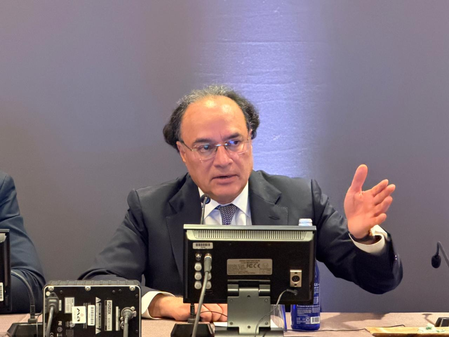
New Delhi, April 17 (IANS) As deliberations on the upcoming budget gather pace, Pakistan Finance Minister Muhammad Aurangzeb’s recent engagement with trade bodies and the business community has thrown up a set of entrenched concerns that continue to weigh on economic activity, according to an editorial in the Karachi-based Business Recorder newspaper.
Stakeholders pointed to the persistently high cost of doing business, tightening liquidity, chronic infrastructure gaps and most importantly, policy uncertainty, which has become the most corrosive drag on the economy, the article states.
It points out that while official narratives increasingly highlight the disruptive impact of a volatile geopolitical environment in complicating economic management – and such pressures are undeniably real – the deeper malaise nevertheless remains domestic in origin.
Long before recent conflicts unsettled global markets, businesses were already operating in an unpredictable policy landscape, defined by abrupt changes to tax policy, a damaging reliance on taxing presumptive incomes over actual incomes, a convoluted regulatory framework governing both domestic and foreign investment, and opaque energy pricing, among other distortions. Policymakers, then, cannot continue to cast the resultant economic instability as a by-product of external shocks alone, the article observes.
It highlights that the core of the economic malaise lies a governance deficit stemming from short-termism, weak institutional coordination and political expedience repeatedly overriding sound economic judgment, alongside a failure to ensure policy clarity and continuity that economic confidence demands.
Tax policy aptly illustrates this uncertainty. Despite years of stated intent to broaden the tax base and lift revenues, outcomes remain weak, with rules and regulations often poorly designed, inconsistently implemented or diluted midway. Compliance with the tax regime has become prohibitively expensive: alongside sharply rising tax rates, businesses face a dense web of procedures, shifting rules and a structurally convoluted system.
An overreliance on indirect taxation, a labyrinthine withholding regime and minimum taxation on turnover irrespective of profitability have together raised the cost of operating in the formal sector. Moreover, the tax base remains stubbornly narrow, with the FBR continuing to squeeze those already in the net, while under-taxed or untaxed segments remain beyond reach, the article laments
These are shielded by their political leverage and successive governments’ inclination to protect entrenched constituencies, whether in retail, agriculture or real estate, with short-term revenue gains being prioritised over the more demanding task of structural reform, the article added.
–IANS
sps/uk