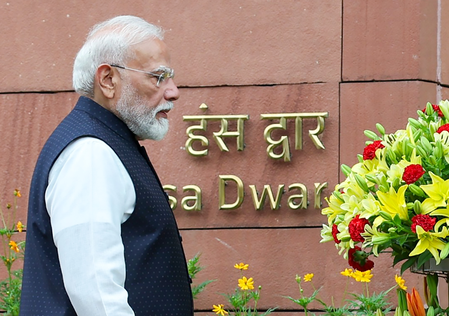
New Delhi, July 30 (IANS) Prime Minister Narendra Modi chaired a high-level meeting of his Cabinet ministers, including Home Minister Amit Shah, Defence Minister Rajnath Singh, External Affairs Minister S. Jaishankar, and Finance Minister Nirmala Sitharaman, at his office in Parliament on Thursday.
The meeting was also attended by National Security Advisor Ajit Doval.
Other ministers at the meeting included Petroleum Minister Hardeep Singh Puri, Health Minister J.P. Nadda, Commerce Minister Piyush Goyal, and Ports and Shipping Minister Sarbananda Sonowal.
According to sources, the meeting was held to review the situation in West Asia and its impact on India’s energy and fuel supplies. The Strait of Hormuz, through which 20 per cent of the world’s oil and gas is exported, continues to remain choked, which has led to a shortfall of petroleum products in global markets and a spike in prices.
The situation has become more complicated with commercial ships coming under attack in the region. The deaths of Indian seafarers have also emerged as a major concern, with the government taking up the issue with Iran and the USA.
The government informed the Parliament this week that it has undertaken a range of measures to ensure availability of critical industrial inputs including energy, ease input cost pressures, facilitate trade, support industrial activity and safeguard macroeconomic stability in the wake of supply chain disruptions due to the West Asia crisis.
The government has also ensured adequate availability of fertilisers and other essential agricultural inputs through assured gas supplies, diversification of import sources, advance procurement, and maintenance of buffer stocks.
The recent geopolitical developments in West Asia have adversely affected countries globally, with major implications for crude-oil-importing emerging economies. The conflict has led to an increase in international crude oil prices, which has widened the crude oil import bill for India.
However, the average Indian crude oil basket prices have eased significantly from $114.5 per barrel in April 2026 to $77.6 per barrel in July 2026 (up to 22nd July).
The government further stated that temporary customs duty exemption was provided on selected petrochemical feedstock. Further, the Bharat Maritime Insurance Pool RELIEF (Resilience & Logistics Intervention for Export Facilitation) Scheme was introduced to support businesses. RoDTEP (Remission of Duties and Taxes on Exported Products) benefits were restored to mitigate higher freight, insurance and war-risk costs. Besides, liquidity support was also extended through the Emergency Credit Line Guarantee Scheme (ECLGS) 5.0.
–IANS
sps/vd