Islamabad, June 8 (IANS) Tragedy of Pakistan-occupied Gilgit Baltistan (PoGB) lies in flawed governance and the normalisation of a political charade. Every five years, polls are held in PoGB under a constitutionally undefined framework that changes governments without changing the actual structure of power, a report has detailed.
“The process is at its core a ritualistic transfer of authority among federally controlled political actors while fundamental questions of constitutional status, political rights, institutional accountability, etc, remain unresolved. This ambiguity facilitates elite capture through a flawed political system that enables control over local resources without meaningful accountability. Public resources continue to be consumed by expanding bureaucratic structures, patronage networks and non-development expenditures,” Afzal Ali Shigri, a former IGP of Sindh province who belongs to PoGB, wrote in leading Pakistani daily Dawn.
“More troubling is the ill-defined governance structure in which critical decisions, including appointments to senior judicial and institutional positions, are made through opaque processes. Such a system effectively guarantees immunity for unaccountable decision-makers, while ordinary citizens continue to bear the burden of weak institutions, unemployment, and political uncertainty. This has reduced Sunday’s election to an exercise in futility,” wrote Shigri.
Instead of locally rooted political structure, governance in PoGB has remained dominated by the Pakistan Muslim League-Nawaz (PML-N), Pakistan Peoples Party (PPP) and Pakistan Tehreek-e-Insaf (PTI), who considered the region through the lens of national power politics, strategic utility, electoral expansion, patronage and resource control, instead of genuine political empowerment.
The first problem is lack of commitment from these parties to resolve the constitutional status of PoGB. At the time of elections, parties make promises of autonomy, reforms and provisional provincial status. However, not a single party has fulfilled their promise when they are in federal power.
The second problem is bringing confrontational mainland political culture into a socially sensitive and geographically isolated region. Local leadership in PoGB often emerges not from grassroot level or public legitimacy, but through patronage networks, loyalty to party centres and access to federal power, leading to weakening of local institutions and prevents independent political consensus.
A new generation is emerging in PoGB, which is educated, technologically connected, politically conscious and not ready to accept symbolic representation in place of genuine rights and participation, according to a report in Dawn. This rising Gen Z may challenge the cycle of constitutional ambiguity and political misgovernance in PoGB as no political structure based on perpetual ambiguity, exclusion and managed dependency can continue for an indefinite period.
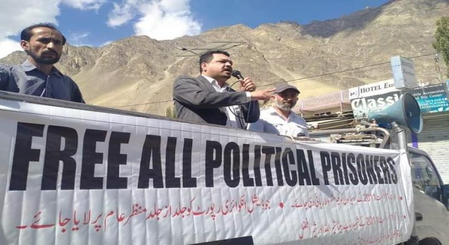
In April, a leading international human rights organisation called on the Pakistani authorities to immediately release all detained activists of the Awami Action Committee (AAC) from Pakistan-occupied Gilgit-Baltistan (PoGB) and drop all charges against them related to their “peaceful activism”.
Expressing its grave concern, Amnesty International mentioned that seven members of the ACC have been arbitrarily detained for over 45 days under Pakistan’s anti-terrorism law, solely for “peacefully” exercising their rights to assembly and expression.
The charges stem from allegations that 13 AAC members made “anti-state” speeches during an Iftar dinner on March 8 and made plans for a protest — rights guaranteed under international human rights law.
According to the rights body, among those detained is 70-year-old lawyer and AAC chairperson Ehsan Ali, whose continued detention has raised serious concerns over his right to life and due process.
“Despite applications filed by his lawyers requesting hospitalisation, Ehsan was denied appropriate medical care until his condition drastically worsened. He was transferred to the hospital only after developing pneumonia and losing consciousness while in police custody. Ehsan has been under police guard at District Headquarters Hospital, Gilgit, along with two other AAC activists, Ibrar Bahoro and Hasnain Ramal. His lawyers have raised concerns that, given his underlying heart condition and current health, the care being provided at the current medical facility is inadequate,” the Amnesty International stated.
The organisation added that other ACC activists named in the case have been forced to restrict their right to freedom of movement, association, peaceful assembly and freedom of expression out of fear of arrest, leaving them unable to campaign for the upcoming elections in PoGB scheduled for June 7, 2026.
The rights body urged the Pakistani authorities to ensure immediate access to adequate healthcare for all detainees pending their release.
–IANS
akl/as