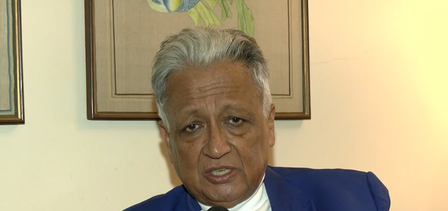
New Delhi, Dec 4 (IANS) As Russian President Vladimir Putin begins his two-day visit to India, former Indian Ambassador to Poland, Deepak Vohra, on Thursday described the visit as highly significant, especially at a time when Russia remains engaged in its war with Ukraine.
He added that President Putin’s arrival sends a message that Russia is not diplomatically isolated and that India continues to stand as an important partner.
Speaking to IANS, Vohra said, “We call every visit a new chapter — it happens every time someone arrives. But this visit, at a time when Russia is facing challenges in Ukraine, truly marks a new chapter. Both sides are exchanging sharp words — Ukraine says, ‘We will do this,’ and Russia responds, ‘Try it, and I will destroy you.’ If a leader leaves his country during such times, it means two things: first, he trusts his system, and second, he wants to demonstrate to the world that he is not alone. China, Iran, and North Korea are not his only partners. He wants to show that the world’s largest democracy, the world’s third-largest economy, one of the strongest militaries, and a nation known for exceptional diplomacy also stands by him.”
Vohra emphasised that the India-Russia relationship extends beyond headlines or momentary political narratives.
“This is probably his 17th or 18th meeting with Prime Minister Narendra Modi, and what does it mean? People will say, ‘Historic moment, game changer.’ After five days, everyone will forget. Another leader will visit, and attention will shift. But the reality is that our friendship is decades old. People say India became independent — that is nonsense. India was partitioned. Yet from then until today, neither the Soviet Union nor Russia has ever threatened India’s core interests. Neither have we worked against theirs. That trust is the foundation of this relationship.”
He further noted that defence ties remain central, but the partnership is broader. “Everyone is talking about defence — Sukhoi-57, S-400 — but defence is just one pillar. Our cooperation extends to energy — and that does not only mean oil, but also nuclear energy, which is a significant component of our bilateral ties. Beyond that, we collaborate in medicine, space, agriculture, education, and cultural exchange.”
Recalling a personal experience, Vohra said, “Years ago, when I was posted in Paris, I attended a dinner where music was playing. Suddenly, I heard ‘Mera Joota Hai Japani.’ People in the Soviet Union adored Raj Kapoor and Mithun Chakraborty. That emotional connection mattered.”
He contrasted Russian and American approaches toward technology sharing. “I once asked my father the difference between Americans and Soviets. He said the Americans were polite and would say, ‘Press this button, it will work; press that, and it will break — call us, we’ll fix it.’ But the Soviets behaved like gurus — they said, ‘Come with us; we will teach you.’ They never treated us as inferiors. Even today, our so-called friends in the US do not share full technology — not even source codes.”
He continued jokingly, “Our neighbour — I call it Jihadistan, you call it Pak — has ships that became old and needed repairs. Americans repaired them, took money, but never taught them how. That is the difference.”
Vohra added that India’s push for local defence manufacturing aligns with Russia’s cooperation model. “Sukhoi aircraft and S-400 systems will now be produced in India itself — that is, self-reliant India. Critics who claim we simply ‘buy’ from Russia will have no argument.”
On India’s continued imports of discounted Russian crude despite Western objections, he said, “Some countries told us to stop buying Russian oil. Why should we? Are they our guardians? We act in India’s best interest. The world has changed. Those who once behaved like emperors now stand as equals.”
Responding to global attention surrounding the visit, Vohra said many nations are watching closely — some with discomfort. “Europe has lost economic and geopolitical influence, yet arrogance remains. A few days ago, ambassadors of Britain, France, and Germany wrote an article in India calling Putin a dictator and questioning why India is hosting him. Who are they to interfere in India’s decisions? We never lecture them on their internal matters.”
He said that countries such as Japan and Australia, which value India’s strategic role, are observing cautiously, while Russia’s rivals are concerned that Putin appears strengthened rather than isolated.
Vohra also criticised US President Donald Trump’s tariff decisions. “Trump imposed tariffs of 25 per cent and 50 per cent on Indian goods, and some feared economic collapse. But look at the numbers — India’s economy continues to grow. My message to Trump is: if you believe tariffs weaken us, raise them to 500 per cent — then see how fast we grow. Trump should stop pretending to understand economics.”
He stressed that Russia has never sanctioned India, unlike the US and Europe. “The more they try to pressure us, the more we diversify partnerships. That is natural diplomacy.”
Citing Chanakya, he said geopolitics is governed by strategic interest, not sentiment. “Chanakya said, ‘The enemy of my enemy is my friend,’ and also, ‘The enemy of my friend is my enemy.’ Western nations must understand this: if Russia is your enemy, it does not automatically make Russia India’s enemy.”
He concluded by saying that India’s ties with Russia remain deeply rooted and durable. “Russia stood by India during its most difficult years and continues to treat us with respect. That is why relations between India and Russia remain strong — not because of temporary convenience, but because they are built on trust, history, and shared strategic interests.”
–IANS
jk/skp