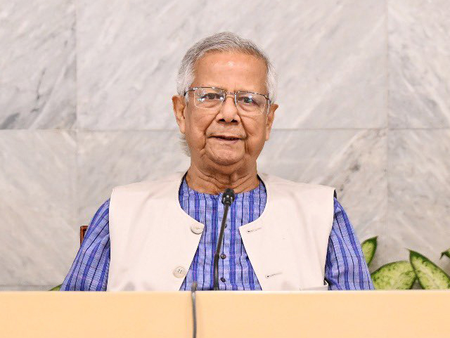
Washington, Feb 6 (IANS) With Bangladesh heading for elections next week, the Muhammad Yunus led interim government which came to power in 2024 following the overthrow of Sheikh Hasina led Awami League government, failed to maintain law and order and deliver on promised human rights reforms, a leading US-based rights group Human Rights Watch (HRW) said in its 2026 World Report.
The HRW stated that the interim government arbitrarily detained thousands of perceived political opponents and, in May, banned the Awami League.
It also noted that the interim government decided to prosecute the most serious crimes allegedly committed during the Awami League’s tenure at Bangladesh’s International Crimes Tribunal (ICT), a domestic court previously used to prosecute crimes under international law committed during the country’s 1971 war of independence.
In November last year, the ICT sentenced Hasina, along with former home minister Asaduzzaman Khan Kamal, to death following trials in absentia for crimes against humanity. A former police chief, who is in custody, testified for the prosecution and was jailed for five years.
“The tribunal had been fraught with violations of fair trial standards, and while the interim government amended the law that establishes the court, introducing some improvements, it still lacks important due process protections and includes the death penalty, in violation of international human rights law. The interim government also gave the tribunal broad powers to prosecute and dismantle political organisations,” the HRW stated.
According to the rights group, one of the key challenges faced by the interim government was an alarming surge in mob violence by political parties and other non-state groups, including religious hardliners hostile to women’s rights and to lesbian, gay, bisexual, and transgender people.
Citing a Dhaka-based human rights organisation, Ain O Salish Kendra, the HRW stated that at least 124 people were killed in mob attacks across Bangladesh between June and August 2025.
The rights body highlighted that on July 26 and 27, last year, a mob damaged at least 14 homes belonging to members of the Hindu minority in Bangladesh’s Rangpur district. The year 2025, it said, also saw reports of persistent violations against minority communities in the Chittagong Hill Tracts, with rape among the crimes committed in attacks targeting minority communities.
Highlighting the violence against women during the Yunus regime, the HRW said, “Sexual and gender-based violence remained widespread, and women and girls had little recourse to seek protection or access justice.”
The rights body stated that women played a pivotal role in the July 2024 demonstrations, but were not adequately represented in the interim government.
In April 2025, the HRW noted that a commission formed by the interim government to propose measures to protect women’s rights recommended steps including criminalising marital rape; providing equal parental rights for women; reforming inheritance laws; and increasing women’s parliamentary representation.
“Soon after, nearly 20,000 supporters of the Islamist organisation Hefazat-e-Islam rallied in the capital, Dhaka, to protest the proposed reforms, among other issues,” it stated.
Bangladesh has witnessed escalating violence against women and children, the rise of mob culture and a deteriorating law and order situation since the Yunus-led interim government assumed power in August 2024.
–IANS
scor/rs