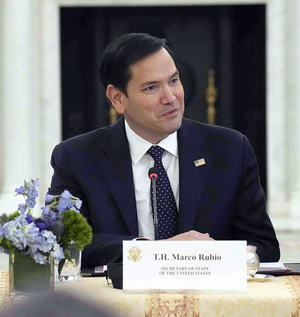
Washington, Jan 29 (IANS) US Secretary of State Marco Rubio on Wednesday told lawmakers that the Trump Administration is pursuing a phased strategy in Venezuela focused on immediate stabilisation, economic recovery, and an eventual democratic transition, while acknowledging that the effort is complex and will take time.
Speaking at a congressional hearing on US policy toward Venezuela, Rubio said Washington’s objective is to reach “a phase of transition where we are left with a friendly, stable, prosperous Venezuela and a democratic one in which all elements of society are represented and free and fair elections.” He cautioned that “we’re not going to get there in three weeks,” describing the process as gradual and difficult.
Rubio argued that the situation under Nicolas Maduro posed a direct risk to US security interests. He said Venezuela had become “a base of operation for virtually every competitor, adversary, and enemy in the world,” naming Iran, Russia, and China. He described it as “an enormous strategic risk for the United States” within the Western Hemisphere.
He said the first phase after Maduro’s removal was preventing disorder. “The concern was what happens in Venezuela? Is there a civil war? Do the different factions start going at each other?” Rubio said, adding that large-scale violence and regional spillover had been avoided.
To stabilise the country, Rubio outlined a temporary mechanism allowing sanctioned Venezuelan oil to be sold at market prices under US oversight. “The funds from that will be deposited into an account that we will have oversight over, and you will spend that money for the benefit of the Venezuelan people,” he said, citing the need to fund basic government functions such as paying police officers, sanitation workers, and other essential services.
Rubio emphasised that the arrangement is limited in scope. “This is not going to be the permanent mechanism,” he said, describing it as a short-term step to prevent fiscal collapse while longer-term reforms are pursued. He also said Venezuela has shifted key energy sourcing to the United States, noting that diluent used to process heavy crude is now coming “100 per cent” from the US rather than Russia.
In the recovery phase, Rubio pointed to early economic and political moves by interim authorities. He said a new hydrocarbon law “eradicates many of the Chavez era restrictions on private investment,” adding that while it “probably doesn’t go far enough,” it represents “a big step from where they were three weeks ago.”
He also cited the release of political detainees. “By some estimates up to 2,000,” Rubio said, though he acknowledged they are being released “probably slower than I would like.” He said the administration is watching closely how those released are treated as they begin to re-enter public life.
Rubio said Washington plans to restore a diplomatic presence in Caracas to engage not only with authorities but also with civil society and opposition figures. He described current contacts as “respectful and productive,” while underscoring that progress will be measured by actions. “We are going to judge actions, not words,” he said.
Addressing concerns about future military involvement, Rubio said the administration does not anticipate any further military action in Venezuela. “The only military presence you will see in Venezuela is our marine guards at an embassy,” he said, while noting that the president retains authority to respond to imminent threats.
Venezuela has faced prolonged economic collapse, mass emigration, and international isolation in recent years, with disputed elections and sweeping sanctions contributing to instability. US officials say the current approach is intended to move the country away from that trajectory toward a more open political and economic system.
–IANS
int/lkj/uk