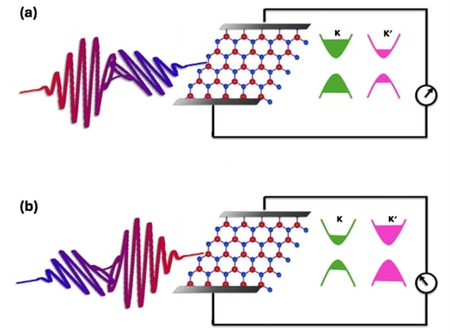
Mumbai, Dec 14 (IANS) Scientists at the Indian Institute of Technology (IIT) Bombay on Sunday announced that they have discovered a simple new way to use light to control quantum states inside ultra-thin materials, a breakthrough that could lead to computers that are far faster and more energy-efficient than today’s electronic devices.
The research focuses on two-dimensional semiconductors, materials that are only one atom thick and thousands of times thinner than a human hair.
Inside these materials, electrons can exist in two distinct quantum states known as valleys, labelled K and K′.
These two states can be compared to the 0 and 1 used in digital computing, forming the basis of a growing research area called valleytronics.
Until now, controlling these valley states has been difficult. Earlier techniques required complex laser setups using circularly polarised light and multiple laser pulses, and even then, the control was often incomplete or hard to measure.
As a result, reliable and reversible switching between the two valley states remained a major challenge.
The IIT Bombay team has now shown that this complex setup is not necessary. In a study published in the journal ‘Advanced Optical Materials’, the researchers demonstrated that a single linearly polarised laser pulse can both control and read the valley state of electrons.
The key lies in introducing a small, controlled skew in the laser pulse’s polarisation.
According to Prof. Gopal Dixit from IIT Bombay, this slight asymmetry in the laser pulse is enough to push electrons into either the K or K′ valley.
By reversing the skew in the pulse, the electrons can be switched back to the other valley. This makes the process fully reversible, with the two valley states effectively acting as quantum versions of 0 and 1.
What makes the discovery even more significant is that the same laser pulse also generates a tiny electric current.
This current acts as a built-in signal that reveals which valley state the electrons have moved into. In simple terms, the system can be controlled and read at the same time, without the need for extra lasers or measuring devices.
The researchers also found that the method works across a wide range of laser wavelengths and does not need to be finely tuned to the material’s energy levels.
–IANS
pk