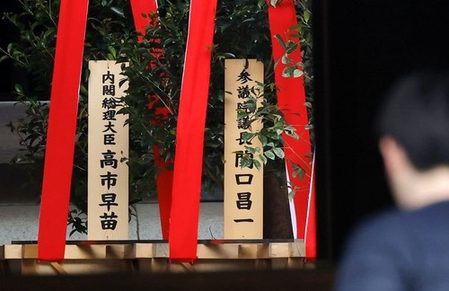
Seoul, April 21 (IANS) South Korea expressed deep regret on Tuesday after Japanese Prime Minister Sanae Takaichi sent a ritual offering to a war shrine seen as symbolising, if not whitewashing, Japan’s militaristic past.
Takaichi sent the offering to the Yasukuni Shrine honouring Japanese war dead, including 14 Class A criminals convicted by the Allies in international tribunals for their roles in World War II, on the occasion of the annual spring festival.
Her key Cabinet members and other lawmakers either visited or planned to visit the shrine in person to pay their respects, reports Yonhap news agency, quoting Japanese media.
“We express deep disappointment and regret that responsible leaders in Japan have repeatedly made offerings to or visited the Yasukuni Shrine,” foreign ministry spokesperson Park Il said in a commentary.
“We urge the Japanese leadership to squarely face history and show through action humble reflection and genuine atonement for historical issues. We once again emphasise that these will be an important foundation for building future-oriented bilateral relations based on mutual trust,” Park said.
Sending an offering or visiting the shrine has drawn criticism from neighbouring countries, including China, which views such actions as an attempt to glorify the country’s militaristic past.
Japan invaded China during World War II, and Korea was under Japan’s colonial rule from 1910 to 1945.
It marked Takaichi’s first offering to the shrine since taking office in October, a move seen as a shift from her previous hard-line approach. Takaichi had regularly visited the shrine to pay respects in person.
Former Japanese Prime Minister Shinzo Abe was the last incumbent Japanese leader to visit the shrine in December 2013.
The Yasukuni Shrine honours some 2.46 million Japanese war dead, many of whom are linked to the Pacific War that began in 1941 with Japan’s attack on the US naval base at Pearl Harbor.
The list on the shrine includes Gen. Hideki Tojo, who was executed in the tribunal for his leading role in the Pacific War.
–IANS
sd/