
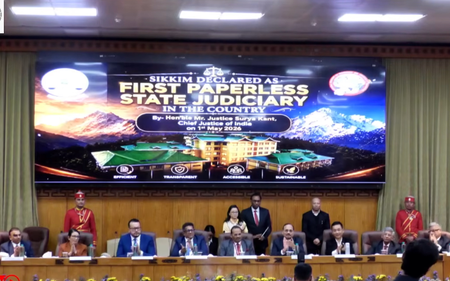
Gangtok, May 1 (IANS) Sikkim on Friday was officially declared the country’s first paperless judiciary, marking a major milestone in India’s judicial digitalisation drive. The formal declaration was made by Chief Justice of India (CJI) Surya Kant during a conclave in Gangtok, attended by judges, legal experts, advocates, and policymakers from across the country.
Addressing the gathering, the Chief Justice of India said access to justice in remote and difficult terrains was undergoing a fundamental transformation through technology. He noted that for litigants in the past, distance was measured not in kilometres but in days of travel, uncertainty, and hardship.
With the rise of digital systems, citizens are now directly connected to judicial forums, reducing procedural delays and reliance on physical paperwork.
The two-day conclave, organised by the High Court of Sikkim and the Sikkim Judicial Academy, is centred on the theme “Technology and Judicial Education”. Discussions are focusing on the future of digital courts, capacity building, and modernisation of judicial institutions.
Speaking at the event, Supreme Court Judge J.K. Maheshwari described the declaration as a remarkable achievement. He said a paperless judiciary does not replace human judgment but removes barriers such as misplaced files, physical distance, and procedural inconvenience.
According to him, the true purpose of technology in justice delivery is to eliminate obstacles between citizens and the courts.
President of the Bar Association of Sikkim, Tashi Rapden Barphungpa, termed the development a landmark moment for the Himalayan state. He said it was historic that a small state like Sikkim had set an example for the rest of the country by becoming the first to adopt a paperless judiciary.
He recalled that there had been initial hesitation among members of the Bar when the electronic court system was introduced. However, as lawyers gradually adapted to the new system and experienced improved efficiency, most concerns subsided.
Barphungpa said the initiative would significantly enhance transparency and accessibility, especially in a state like Sikkim, where travel is often disrupted by landslides and adverse weather during the monsoon.
Digital filing and virtual appearances, he said, would allow lawyers and litigants to participate in proceedings from their homes or offices.
Senior Advocate of the High Court of Sikkim, Jorgay Namka, said the recognition was a matter of pride and an opportunity for the state. He credited the achievement to sustained cooperation among the judiciary, advocates, and the state government.
He said the shift to a paperless system would improve judicial connectivity in remote parts of Sikkim and help ensure that justice reaches every citizen.
For a small state, he added, the accomplishment reflects a strong willingness to embrace innovation and modern governance.
Namka also said hosting a national-level judicial conclave in the presence of the Chief Justice of India, Supreme Court judges, and delegates from India and abroad was itself historic and would open new avenues for Sikkim’s institutional growth and visibility.
–IANS
tdr/dan