New Delhi, Dec 30 (IANS) For the first time in decades, general elections in Bangladesh will be held in the absence of the two biggest women political rivals, following the death of former Prime Minister Khaleda Zia, while ex-premier Sheikh Hasina remains in exile in India.
As Bangladesh heads towards a new political era, treading through uncertainty and violence, the spotlight has shifted to Zia’s son, Tarique Rahman, who is leading an alliance as the acting Chairman of the Bangladesh Nationalist Party (BNP).
His return to Dhaka after 17 years in exile has reignited debates about the future of India–Bangladesh relations.
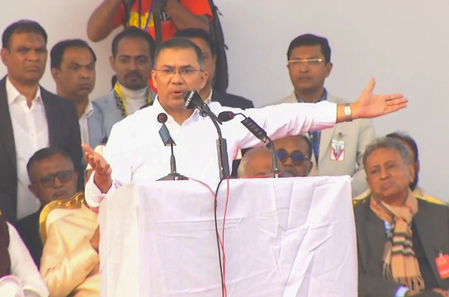
Thus, his maiden address to a large gathering on Thursday after landing in his country was closely monitored. While appealing to BNP’s nationalist base, which often does view India with suspicion, he positioned himself as a defender of Bangladesh’s sovereignty, indicating equidistance from India, China, and Pakistan.
He also insisted on an all-inclusive society, encompassing citizens of all faiths and religions.
Rahman spoke of a country where there will be peace, security, and unity, at a time when the current volatility has posed a major threat to law-and-order and to life itself.
In the domestic political field, his main challenge comes from another grouping, at the head of which is Bangladesh Jamaat-e-Islami.
In the past, however, the BNP and Jamaat have repeatedly been allies, most notably during Khaleda Zia’s rule in the early 2000s, when her cabinet comprised ministers from the latter.
However, the BNP now appears to have distanced itself from the Jamaat, where the latter has formed a coalition of its own for the February 2026 election. Among its constituents is the recently registered National Citizens Party (NCP), a student-led political party that grew out of the Students Against Discrimination (SAD) movement, which spearheaded last year’s uprising against the then Hasina-led government.
However, there is strong resentment within the NCP over the alliance, and some of its leaders have already resigned in protest.
Earlier, Jamaat leaders like Ali Ahsan Mohammad Mujahid and Motiur Rahman Nizami served as cabinet ministers in the 2001–2006 government when the BNP formed a coalition government with it. The alliance gave Jamaat mainstream political legitimacy, though it was controversial due to its reported pro-Pakistan role in the 1971 war for Bangladesh’s liberation. But the partnership helped BNP consolidate conservative and Islamist votes, which were strongly opposed to the principal rival Awami League party.
The alliance was thus seen as a counterweight to the Sheikh Hasina-led party, which leaned toward secular and pro-India policies.
The electoral cooperation continued through the 2010s, but there were accusations against them over harbouring an Islamist agenda.
Sheikh Hasina’s coalition government had banned the Jamaat and its student wing, Islami Chhatrashibir, following the violent protests last year. This was later lifted by the interim administration led by Chief Adviser Muhammad Yunus.
However, in the run-up to the 2026 elections, the BNP appears to have formally severed ties with the Jamaat, where Tarique Rahman has emphasised a more centrist, secular appeal, targeting Sheikh Hasina’s former support base.
Incidentally, the Awami League has been barred from contesting the 2026 election, with Hasina handed a death sentence for alleged atrocities during her rule.
This will be the first time since Bangladesh’s independence in 1971 that the party, originally founded by Sheikh Mujibur Rahman in erstwhile East Pakistan, has been formally excluded from national polls.
Distancing from the Jamaat may broaden appeal for BNP among secular voters and improve international credibility in the absence of Sheikh Hasina, though her exile will remain an issue.
For India, the break with Jamaat could be seen positively, as it has historically been viewed as pro-Pakistan and anti-India.
Even considering the proverbial slip – here between the political cup and the lip – it may be too early to compare Khaleda Zia’s legacy to judge Tarique Rahman’s future stand on relations with New Delhi.
–IANS
jb/vd