New Delhi, Jan 6 (IANS) United States operation to capture Venezuela’s President Nicolas Maduro is a decisive demonstration of a new Washington posture that prioritises the Western Hemisphere, even at the potential expense of long‑standing focus on China in the Indo‑Pacific, according to a report.
“The military has followed through by pulling most of the 12-plus ships in the Caribbean from previously planned European and Pacific deployments. This includes the U.S.S. Gerald R. Ford, which was on a scheduled cruise in the Mediterranean along with its destroyer escorts before getting sent to the Caribbean in October,” reported Politico, an American digital newspaper with focus on politics and policy.
Significantly, it found, “That left a gap in long-planned U.S. naval presence in and around Europe.” The report analysed the scale of preparation with input from sources. The exercise involved months of naval buildup, carrier task forces diverted from other theatres, and a special operations raid executed by elite units.
Thus, the move underscores a willingness by the administration to deploy high‑end military capabilities close to home rather than reserve them primarily for deterrence against great‑power rivals, it deduced. This reorientation is not merely tactical; it reflects a strategic choice about where Washington believes its most urgent threats and opportunities lie, and it forces a reappraisal of force posture, logistics, and alliance commitments across theatres.
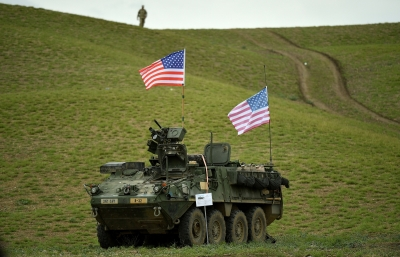
“But doing that while pulling off operations like Saturday’s extraction of Maduro and his wife could prove challenging. It required months of planning and a huge American naval armada supported by squadrons of fighter planes and drones stationed in Puerto Rico and elsewhere in the region,” observed Politico.
“Those forces remain in place or on standby, including destroyers armed with long-range Tomahawk cruise missiles, long-range bomber flights stationed in the continental U.S. and a special operations ‘mothership’ prowling the coast of South America,” it added.
And significantly, “All those weapons would figure heavily into a potential confrontation with China, but instead are being deployed in a region where the U.S. has no major superpower competitor.” Incidentally, Beijing recently launched a massive war game, almost surrounding Taiwan, an independent democracy that China historically considers part of its territory. China was wary of the US pledging a record arms sales to Taiwan, and the National Security Strategy (NSS) document that expressed an interest in working “to align the actions of our allies and partners with our joint interest in preventing domination by any single competitor nation”.
Apparently, what weighed more on President Trump could have been another matter mentioned in the December-released NSS. It is set to rediscover the more than 200-year-old foreign policy statement known as the Monroe Doctrine, drafted against European colonialism in the Western Hemisphere. Created in 1823 by President James Monroe as part of foreign policy, it viewed any intervention by foreign powers in the political affairs of the Americas as a hostile act against the US.
“The bigger question is overextension,” said the report, quoting a source from the defence department. “We aren’t manning every spot as it is…Imagine if Iran pops again,” added the official. “The U.S. may be able to avoid overcommitting itself, but only in the near team,” the report quoted Bryan Clark, a retired Navy officer and a senior fellow at the Hudson Institute, a conservative think tank.
He noted officials have been pulling ships from European and Middle East deployments for the Western Hemisphere mission. The Politico claimed that if the ships see their usual six-to-eight-month deployments extended, “the Navy will likely have problems with planned maintenance schedules and crew rest”. It assumed that given Trump’s renewed warning to Cuba and Colombia, the US President will likely need American forces to stay in the region as a potential cudgel to keep the pressure on.
Clark further told the digital newspaper, “‘If they extend these ships or send the next deployers to (U.S. Southern Command) then we will see an impact,’ because Navy presence will be effectively reduced to existing forces already in Europe or Japan.”
–IANS
jb/uk