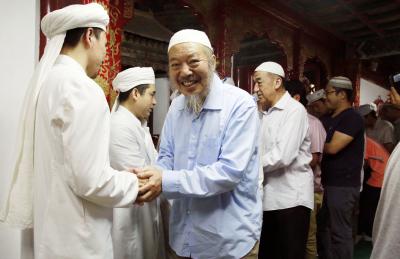
Rome, July 1 (IANS) A recent seminar in Beijing underscored the evolution of China’s Sinicisation of Islam — a campaign which requires religious groups to align their doctrines, customs and moral values with Chinese culture. Increasingly, the initiative has shifted beyond cultural adaptation to become a political programme that expects religious leaders to internalise and promote Chinese Communist Party’s (CCP) doctrine, according to a latest report.
The prominence of Chinese President Xi Jinping’s thought throughout the training reflects the extent to which the process has evolved. Islam is being reinterpreted through a political lens, while religious leaders are being trained to guide the faithful in line with the party’s ideological framework, a report in the Italy-based online magazine ‘Bitter Winter’ detailed.
“The latest training programme for imams and Islamic teachers, held from May 10 to 16 at the Central Institute of Socialism in Beijing, offered another glimpse into the direction China expects Islam to take. The event was presented as a seminar on the Sinicisation of Islam, yet the curriculum focused almost entirely on Xi Jinping’s political thought. The Quran appeared only as a distant backdrop, while the real focus was on consolidating ideological loyalty,” the report mentioned.
“The opening speeches set the tone. Participants were told to study Xi Jinping’s views on religion, absorb “Xi Jinping Thought on Socialism with Chinese Characteristics for a New Era”, and cultivate what officials called the correct understanding of the nation, ethnicity, history, culture, and religion. The language echoed the formula now used across all officially recognised faiths: religious leaders are expected to guide believers toward identification with the state, the Party, and the narrative of national rejuvenation,” it added.
According to the report, the training was less a discussion of Islamic theology and more an exercise in political indoctrination. The seven-day programme featured lectures on Xi Jinping Cultural Thought, the CCP’s approach to religious governance, and the construction of a unified national identity.
“Forty-five imams and Islamic educators from across China attended. Their task was to learn how to reinterpret Islam in ways that reinforce the Party’s priorities. The emphasis on governance according to law referred not to Islamic jurisprudence but to the regulatory framework that places all religious activity under state supervision,” it stated.
The report noted that the trend reflects a broader effort to reshape all religions into vehicles for a state-approved cultural identity.
The closing ceremony reinforced the same message: “Islamic clergy must contribute to China’s modernisation and to the project of national unity.” While the Party’s rhetoric permeated every aspect of the event, the report said, the training was presented as a patriotic duty, with participants reminded that “their role is to guide believers toward loyalty to the state.”
–IANS
scor/as