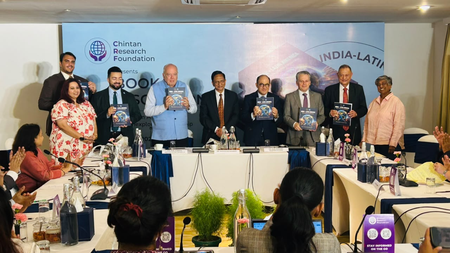
New Delhi, June 23 (IANS) India and Latin America have a unique opportunity to transform a long-overlooked relationship into a meaningful strategic partnership as global supply chains continue to be reshaped by geopolitical uncertainty, economic fragmentation, and growing concerns over strategic dependencies, according to a roundtable discussion convened by the Chintan Research Foundation (CRF).
The discussion, titled ‘India-Latin America: The Unexplored Partnership’, was organised in New Delhi on Monday, bringing together the ambassadors of Uruguay, Argentina, Colombia, Guatemala, Panama, and Costa Rica, along with academics and experts from the strategic community, to deliberate on pertinent themes and issues concerning the India-Latin America relationship.
Speakers at the discussion emphasised the need to update the narrative surrounding India–Latin America relations to better reflect the significant developments that have taken place in recent years and to institutionalise existing channels of engagement across political, economic, strategic, and societal domains, according to an official statement.
The statement further stated that the speakers also highlighted the importance of strengthening India’s political presence in Latin America and the Caribbean through more frequent high-level visits and sustained diplomatic outreach.
The speakers drew attention to India’s upcoming BRICS presidency and Uruguay’s presidency of the Community of Latin American and Caribbean States (CELAC) and called it an “opportunity to deepen dialogue and cooperation between the two platforms and advance a more structured India–Latin America partnership”.
The roundtable also deliberated on why a relationship marked by strong economic complementarities continues to remain peripheral to mainstream strategic and policy debates.
“While India and Latin America are frequently described as regions of untapped potential, participants stressed that this potential has yet to be translated into sustained political engagement, institutionalised cooperation, or diversified commercial partnerships,” the statement read.
A major theme of the Chintan Research Foundation discussion was the changing geopolitical and geo-economic landscape shaping India-Latin America relations. The participants reflected on the “fragmentation of global trade, the securitisation of supply chains, rising protectionism, and the growing use of economic interdependence as a geopolitical tool”.
The participants noted that the relationship has evolved from being largely unexplored to a phase of active engagement and discovery. They stressed that the subsequent stage should be characterised by “complementarity”, which will pave the way for deeper convergence between India and the Latin American region.
“In this context, stronger India-Latin America engagement was viewed not as a substitute for existing partnerships, but as a means of enhancing strategic flexibility, economic resilience, and diversification,” the statement read.
The discussion at the Chintan Research Foundation also examined the implications of China’s significant economic presence throughout Latin America.
According to the participants, India should avoid viewing the region solely through the lens of competition with China, but with an approach “anchored in its own comparative strengths, including demand-driven cooperation, capacity building, affordable technologies, pharmaceuticals, digital public infrastructure, and partnerships aligned with local development priorities”.
The CRF roundtable emphasised that India could play a key role in adding value to local products and strengthening domestic economic capacities in Latin America.
“The presence of Indian enterprises that have established a meaningful local footprint and contributed beyond conventional trade and investment was cited as a notable example,” the statement about the discussion added.
However, according to the discussion, translating potential into outcomes will require sustained political attention, stronger institutionalisation of these relations, greater private-sector participation, and a focus on a limited number of sectors where visible progress can be achieved in the near term.
Stressing that India-Latin America relations should no longer be treated as a peripheral component of foreign policy, participants suggested, instead, in an era of geopolitical realignment and economic uncertainty, the partnership can play “a vital role in advancing trade diversification, resource security, technological cooperation, resilient supply chains, and a more balanced framework of South-South cooperation”.
“The challenge today is no longer to identify the potential of India-Latin America relations, but to convert that potential into a durable, structured, and mutually beneficial strategic partnership,” the statement read.
Speaking at the roundtable, CRF President Shishir Priyadarshi reaffirmed that the foundation “will continue to provide a platform to build on existing efforts and facilitate deeper dialogue, research, and discussion on the relationship”.
The discussion concluded with broad agreement that the foundations for a stronger India-Latin America partnership are already in place.
–IANS
sd/