New Delhi, July 31 (IANS) India has built a strong foundation for semiconductor design through ISM 1.0 by expanding access to EDA tools across more than 340 institutions, supporting startups, and creating a vibrant innovation ecosystem, IT Secretary S. Krishnan said on Friday.
With Semicon 2.0, “our focus is to help Indian companies scale, strengthen indigenous intellectual property, attract greater private investment, and, most importantly, transform world-class chip design into globally competitive products,” he said an event here.
The government this month approved the ‘Semicon 2.0’ scheme for the development of a domestic semiconductor design and manufacturing ecosystem, with a total budget outlay of Rs 1,27,500 crore. To date, 12 manufacturing units have been approved with a cumulative investment of over Rs 1.64 lakh crore.
Krishnan further stated that the government is committed to building the enabling ecosystem, expanding access to cutting-edge design infrastructure, strengthening indigenous IP, and creating the right conditions for industry and academia to drive innovation.
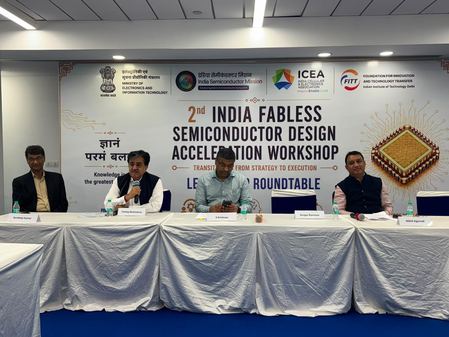
“Together, we must ensure that India’s semiconductor capabilities translate into products designed, owned, and commercialised from India, positioning the country as a leading global semiconductor product nation,” he said during the second ‘India Fabless Semiconductor Design Acceleration Workshop’ at IIT Delhi.
The event was organised by the India Cellular and Electronics Association (ICEA), in collaboration with FITT, IIT Delhi.
Amitesh Kumar Sinha, CEO, India Semiconductor Mission (ISM), said that ‘Semicon 2.0’ marks the next phase of India’s semiconductor journey by creating a more inclusive and innovation-driven ecosystem.
“The expanded framework will enable startups, established companies, overseas collaborators, and investors to participate in building India’s semiconductor capabilities. By strengthening long-term financing, fostering indigenous IP, improving market access, and supporting the transition from chip design to commercial products, we are laying the foundation for globally competitive Indian semiconductor companies,” Sinha noted.
The workshop deliberated on building indigenous semiconductor products for high-growth sectors including mobile phones and wearables, consumer electronics and televisions, air conditioners and home appliances, IT hardware and data centres, automotive and electric vehicles, and others.
Pankaj Mohindroo, Chairman, ICEA, said that India has taken the first steps towards building its semiconductor ecosystem.
“The next phase must focus on creating Indian-owned semiconductor products, IP and globally competitive technology companies. As India’s electronics manufacturing ecosystem expands rapidly, semiconductor development must be driven by the needs of sectors such as mobile phones, consumer electronics, automotive, IT hardware, telecom, industrial electronics and power electronics,” he mentioned.
–IANS
na/