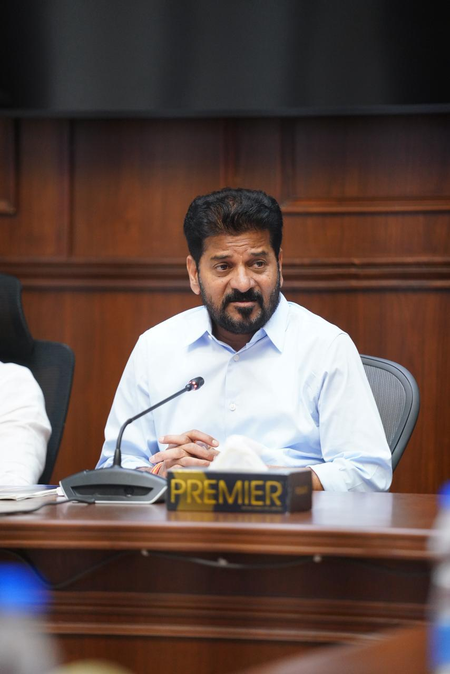
Hyderabad, April 14 (IANS) Telangana Chief Minister A. Revanth Reddy on Tuesday urged his counterparts from other southern states and Union Territory of Puducherry to unitedly resist the Centre’s moves to push a ‘pro rata model’ to increase Lok Sabha seats, saying this would be highly determinantal and inimical to interests of southern states.
Revanth Reddy wrote separate letters to the Andhra Pradesh Chief Minister N. Chandrababu Naidu, Tamil Nadu Chief Minister M.K. Stalin, Karnataka Chief Minister Siddaramaiah, Kerala Chief Minister Pinarayi Vijayan and Puducherry Chief Minister N. Rangasamy sharing his deep concern regarding the proposed move to increase number of Lok Sabha seats, using the pro rata method, saying that this has far-reaching implications for southern states and for the federal balance of the country.
He emphasised the growing need for collective engagement among southern states, and all like-minded states, to ensure that our concerns are articulated effectively at the national level.
The Telangana Chief Minister noted that women’s reservations, national delimitation and increase in seats for Lok Sabha are three different issues, which are being deliberately mixed to cause confusion in public mind.
The Congress leader wrote that those all in support of the Women’s Reservation Bill (without linking it to increase of seats) or delimitations only want to change boundaries of Assembly constituencies within states.
“The real contentious issue is the proposal to increase Lok Sabha seats to 850 seats using a pro rata basis. We will and must totally oppose the increase in seats using pro rata method,” w Revanth Reddy said.
He noted the arithmetic underlying a pro-rata model and how it changes political power gap between states.
“Under such a framework, while all states may see an increase in absolute number of seats, relative gap between states will widen significantly. For instance, Andhra Pradesh currently has 25 Lok Sabha seats, while Uttar Pradesh has 80 seats, a gap of 55 seats. Under their proposed model, Andhra Pradesh will increase from 25 to around 38 seats, whereas Uttar Pradesh will increase to 120 seats. This expands the political gap from 55 seats to 82 seats, thereby structurally widening the imbalance in representation,” Telangana CM Revanth Reddy said in the letter to his Andhra Pradesh counterpart Chandrababu Naidu.
In the letter addressed to Tamil Nadu Chief Minister Stalin, he said: “Under the proposed model, the Lok Sabha seats in Tamil Nadu and Puducherry together may increase from 40 to around 60 seats, whereas Uttar Pradesh may rise to around 120 seats. This expands the political gap from 40 seats to 60 seats.”
Revanth Reddy, in the letter to Karnataka CM Siddaramaiah, said: “Under their proposed model, Karnataka’s Lok Sabha seats will increase from 28 to around 42, whereas Uttar Pradesh will increase to 120 seats. This expands the political gap from 52 seats to 78 seats.”
He similarly explained how the proposed model would widen the political gap between Kerala and Uttar Pradesh from 60 seats to 90 seats.
“The pro rata method therefore effectively means that the voice and influence of your state in Parliament will diminish in relative terms, even as its contribution to the nation continues to grow,” the letters said.
The Telangana Chief Minister pointed out that southern states have invested heavily in population stabilisation, public health, education, and economic development, thereby contributing significantly to India’s growth story.
“However, under a population or pro rata model, these very achievements are rendered inconsequential in determining political representation. The consequence of this approach is a systematic dilution of the political voice of southern states. As representation becomes increasingly skewed towards regions with higher population growth, national policy priorities risk being shaped without adequate participation from states that have been at the forefront of economic and social progress. A framework that does not take into account such contributions risks creating a perception of inequity that could have long-term implications for national cohesion. However, under the present proposal, our states are being structurally disadvantaged and politically unempowered. The consequence of a pro rata model is not merely a statistical adjustment; it will result in a systemic shift in political power,” Revanth Reddy wrote.
“As you are aware, in the matter of financial devolutions, we are facing severe financial injustice, bias and discrimination, wherein while Bihar received more than Rs 6.69 for each rupee it contributes, your state of Andhra Pradesh gets 63 paisa for the same tax contribution. This is just an example of the South-North divide that we are facing for decades. But with this change in Lok Sabha seats, we will be punished with political injustice over and above continued financial and policy discrimination. Southern states, despite their substantial contribution to the national economy, will witness a relative erosion of their voice in Parliament, while states with higher population growth in a northern-central belt, will gain disproportionately. This effectively translates into a scenario where progress is penalised and demographic expansion is rewarded,” he wrote to Chandrababu Naidu.
In letters to other Chief Ministers, the Telangana Chief Minister highlighted the contribution of their respective states and what they receive from the Centre compared to Bihar.
Referring to a constructive alternative hybrid model, which seeks to balance representation with contributions, Revanth Reddy said this could be an ideal solution.
“Since they are proposing to increase existing Lok Sabha from 543 seats to 850 seats, we demand that only half of the increased new seats can be done using Pro Rata model. Remaining half, must be distributed based on economic contribution (GSDP), and other performance criteria. This is just one suggestion, a possible approach,” he noted.
“In this regard, let us all join to launch a coordinated effort with unity to address this issue. India’s strength lies in its diversity and the equitable representation of all its regions. It is our collective responsibility to ensure that this balance is preserved,” he said.
–IANS
ms/khz