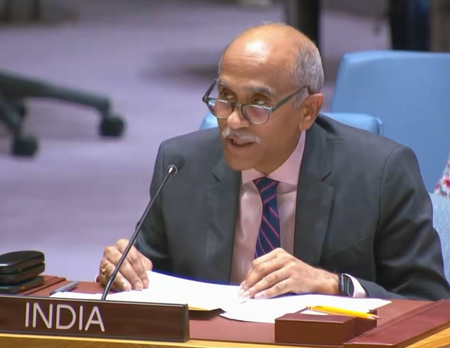
United Nations, July 23 (IANS) India has drawn attention to the exploitation of Balochistan for its rich natural resources that has led to an uprising by the province’s people against Islamabad.
“It is the responsibility of States to ensure that subnational provinces that are rich in resources, like oil and gas, minerals, rare earths and precious metals … have an equitable and just share in the benefits derived from these resources”, India’s Permanent Representative P. Harish said on Wednesday.
This is “to avoid internal instability and insecurity, not just within such countries, but also in the wider region,” he said.
Diplomatically, without naming Pakistan, he made it clear that this failure applied to the situation in Balochistan: “The consequences of not doing so are clearly visible, including in our own region”.
The province that is rich in natural resources and contributes disproportionately to Pakistan’s economy remains one of the poorest in that nation.
That has led to protests by Balochis demanding a fair share of the contributions made by their province, with their brutal suppression fueling an insurgency.
“A heavy-handed and securitised approach to governance of resource-rich provinces only makes matters worse,” Harish warned.
“Provinces that are resource rich but development poor become centres of insecurity that radiate instability beyond their borders, even into neighbouring countries,” Harish said.
“This instability also attracts transborder interventions and resource extraction by external actors, which further exacerbates grievances of local communities and fuels instability,” he said.
Speaking at the high-level open debate on “Natural Resource Governance: The Foundation of Peace, Security and Prosperity”, Harish said, “The primary responsibility for the governance and management of natural resources rests with sovereign States”.
“National ownership, capacity-building and institution strengthening should therefore remain at the centre of all national and international efforts,” he said.
In parts of Africa, in particular, armed groups and terrorists have fought to control natural resources, and this has financed their activities, leading to civil wars and local conflicts that exact a high price on the people.
Harish said, “India recognises that the illicit exploitation and trafficking of natural resources can, in certain situations, contribute to the financing of armed groups, and prolong conflict.”
“However”, he added, “we must remember that natural resources are, first and foremost, an engine of development and prosperity for sovereign States”.
The challenge is in “ensuring that they are governed in a transparent, accountable and nationally owned manner for the benefit of present and future generations,” he said.
Secretary-General Antonio Guterres said, “Countries and communities must benefit — first and most — from the resources in their own backyard”.
He referred to the colonial exploitation of the countries of the Global South and the continuing pattern “where resources are extracted, value is captured elsewhere, and impoverished communities are left behind to cope with the environmental and socioeconomic damage”.
“It is time to close the gap between a State’s recognised sovereignty over its natural resources, and its sovereign rights in practice,” he said.
“Nowhere is this sovereignty deficit wider than in Africa, where the enduring consequences of colonialism, coupled with governance challenges, put States at a steep disadvantage when seeking to capture or reinvest the value that lies in their natural resources,” he said.
–IANS
al/dpb