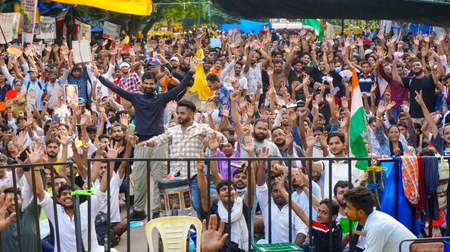
New Delhi, July 26 (IANS) It should never have taken a street protest to force governments to address a problem that has plagued India’s examination system for many decades. But that is precisely what the Cockroach Janata Party’s (CJP) protest at Jantar Mantar in Delhi has exposed.
The protest, though projected as an agitation against examination paper leaks and carrying an unmistakable political hue, has brought to the fore a problem that has plagued the country for decades.
Year after year, India has witnessed discrepancies in examinations. Sometimes paper leaks were detected; perhaps many more went unnoticed and unaddressed. One can only imagine how many doctors, engineers, policemen and other public servants may have secured their positions through unfair means. Every time a leak surfaced, the routine response was to cancel the examination and conduct a retest. That has been the story for decades.
This time, however, students have had enough; their anger forced the government to act, something that should have happened long ago without public pressure.
It was in 1986, under the Rajiv Gandhi government, that the National Policy on Education (NPE) formally acknowledged examination malpractices as a serious threat to academic integrity. It recognised systemic vulnerabilities, noting that everything from evaluation bias to the physical security of question papers required urgent attention. The policy laid the conceptual groundwork for treating paper leaks as a major security issue affecting students, but a comprehensive central law to deal with organised paper-leak syndicates never materialised.
None of the political parties or governments at the Centre that followed seriously attempted to plug these loopholes. Since 1986, Congress remained in power or was in coalition for nearly 23 years until 2014, yet it failed to address the menace through a dedicated legal framework.
It was only in 2024, after nationwide outrage over repeated leaks in major entrance examinations, that India enacted its first dedicated anti-paper leak law — the Public Examinations (Prevention of Unfair Means) Act, 2024. The law came into force on June 21, 2024, specifically targeting central testing agencies.
Despite the new legislation, paper leaks have continued, with the 2026 NEET paper leak becoming the latest flashpoint.
The CJP, a collective of young people reportedly backed by the Aam Aadmi Party (AAP) and projecting itself as the voice of Gen Z, found an opportunity in the growing public anger. With activist Sonam Wangchuk sitting on a hunger strike at Jantar Mantar, the protest acquired momentum and threatened to snowball into a nationwide movement.
The agitation, which turned violent and reportedly left nearly 200 policemen and dozens of protesters injured, should serve as a wake-up call not merely for the government but for the entire political establishment.
Whether certain political forces attempted to fuel the protests or derail them through violence is a separate debate. What cannot be ignored is the deep frustration among the country’s youth over a system repeatedly compromised by examination leaks.
For far too long, India’s political class has taken people for granted. Fundamental issues have often been overshadowed by the compulsions of electoral politics. Even today, most parties continue to view such issues primarily through the prism of vote-bank calculations.
Take the NEET paper leak as an example. The controversy surfaced in April, but Congress became visibly active only after the CJP protests gathered a certain momentum and Sonam Wangchuk’s agitation began attracting public support. Rahul Gandhi, returning after a 20-day foreign tour, suddenly made the issue a political priority as Parliament’s Monsoon Session approached. He held special media events, including one near the Prime Minister’s residence, to underline his party’s concern.
AAP national convenor Arvind Kejriwal, widely perceived as the force behind the CJP, also faces uncomfortable questions. His party’s government in Punjab has repeatedly been accused of failing to curb examination scandals in the state. It is alleged that six paper leaks have taken place over the past four years.
The Congress, the Shiromani Akali Dal and the BJP have all accused the Punjab government of recruitment irregularities and repeated examination leaks, demanding the resignation of Education Minister Harjot Singh Bains. Interestingly, whenever CJP leaders are questioned about the Punjab paper leaks, they conveniently sidestep the issue.
The Samajwadi Party, too, has been vocal over the present controversy. But it was the Mulayam Singh Yadav government that abolished Uttar Pradesh’s stringent Anti-Copying Act in 1994. The law had been introduced in 1992 by the BJP government led by Chief Minister Kalyan Singh to curb rampant cheating in examinations. After assuming office, the Samajwadi Party repealed it, describing it as excessively harsh on students.
Then, in 2015, when Mulayam Singh Yadav’s son Akhilesh Yadav was the Chief Minister, it took the intervention of the Allahabad High Court to force the removal of Uttar Pradesh Public Service Commission chairman Anil Yadav.
Anil Yadav was accused of favouring one particular community in recruitment to various government posts. Students repeatedly agitated against him, and several protests ended in police lathi-charge. He also courted controversy after the 2015 PCS (Preliminary) examination paper leak.
Whatever forces may have helped propel the CJP protest, the agitation has undoubtedly shaken the system and compelled the government to respond.
The real lesson from the CJP protests is not about one organisation or one government. It is about a political culture that responds only when public anger spills onto the streets. A system that waits for protests before correcting its failures is not merely inefficient; it has already failed the very people it is meant to serve.
(Deepika Bhan can be contacted at deepika.b@ians.in)
–IANS
dpb/sd/