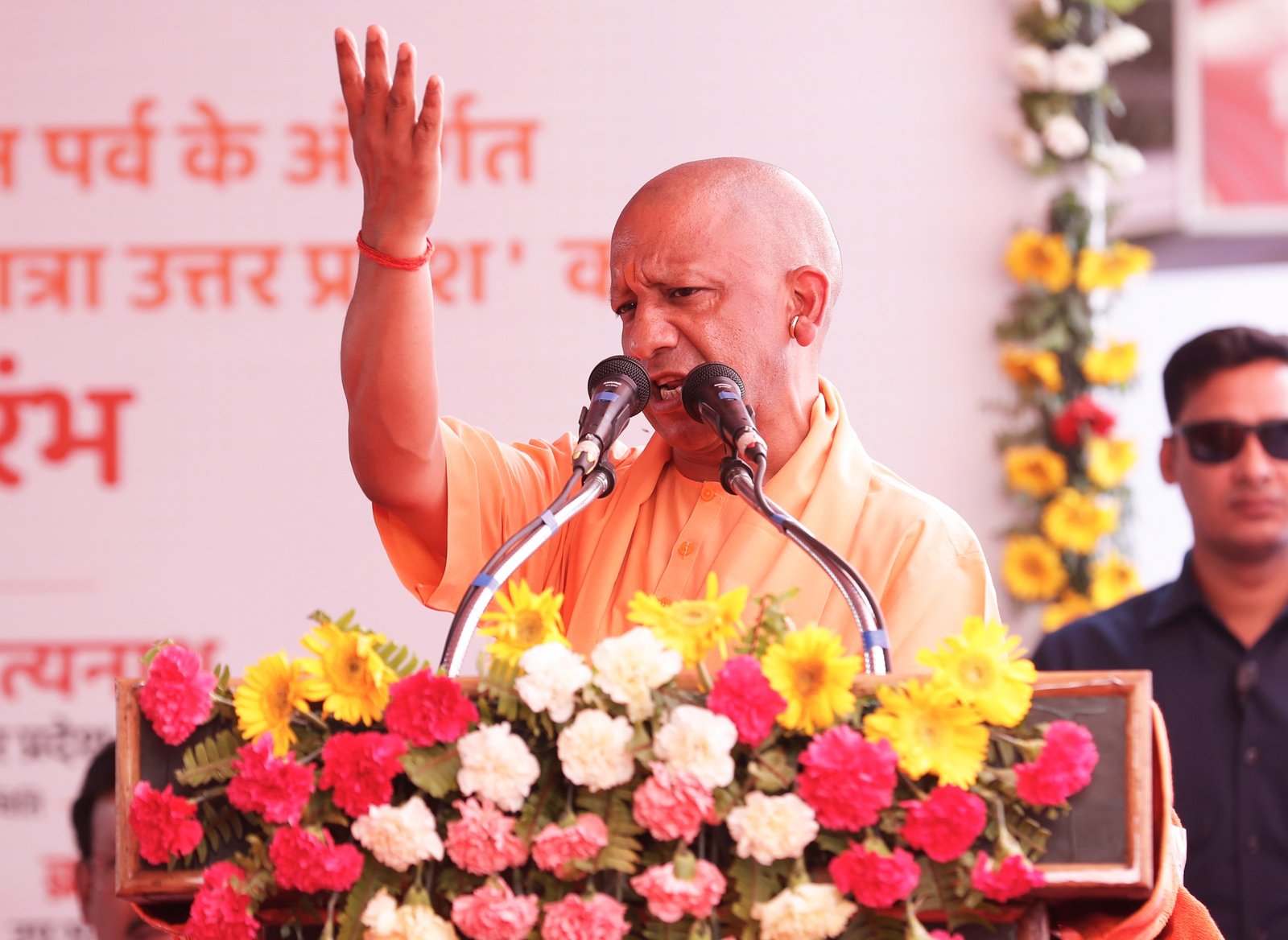
CM and Gorakhpeethadhishwar Yogi Adityanath said the objective of foreign invaders was not merely to loot India’s glory, but also to destroy its knowledge tradition and intellect. Attacks on temples were part of this very thinking. During British period, method changed and attempts were made to create confusion and sever Indians from their traditions, values and roots. “Now is the time to recognize our knowledge tradition, present it before the world with evidence and connect it with modern technology to take it to new generation.”
CM addressed the lecture session of the seven-day death anniversary program organized at Shri Gorakhnath Temple on the 57th death anniversary of Yugpurush Brahmalin Mahant Digvijaynath and the 12th death anniversary of Rashtrasant Brahmalin Mahant Avaidyanath on Thursday.
Referring to attacks on the ashrams of sages in Dandakaranya during the Ramayana period, CM observed that whether they were demonic and evil forces or foreign invaders, the objective behind attacks on India was not only to loot its wealth but also to destroy its knowledge heritage. Referring to Mahmud Ghaznavi’s attack on the Somnath Temple, he remarked that objective of destroying the temple was not merely plunder, but also to destroy the Sanatan tradition.
CM noted that during the British period, method changed. “Indians were confused about their language, medical system and knowledge tradition. English was given importance in place of Sanskrit and modern medicine was given importance in place of traditional medical practices. As a result, we gradually became disconnected from our traditions, values and roots.”
Chief Minister stated that India was called a Vishwaguru because of its knowledge tradition. “History of many developed countries today is 400 to 500 years old, whereas in India, universities such as Takshashila existed 2600 years ago and Nalanda existed around 1700 to 1800 years ago. Kashi, Ujjain, Kanchi and Navadwip were also major centers of knowledge.”
He noted that Kumbh was not merely an occasion for bathing. “At Prayagraj, Haridwar, Ujjain and Nashik-Trimbakeshwar, saints and scholars used to discuss their research and innovations. Indian society has even today connected its festivals, celebrations and auspicious occasions with the Indian Panchang.”
CM informed that more than 01 lakh ancient manuscripts have been collected at Sampurnanand Sanskrit University, Kashi and their preservation and digitization work is underway. Such knowledge heritage is also present in the homes of families and scholars, as well as in ancient monasteries and temples. Manuscripts, copper plates, and inscriptions have been found in various places, including Ayodhya, Prayagraj, Mathura-Vrindavan, and Lucknow.
CM Yogi stated that three aspects would emerge while taking the Indian knowledge tradition forward. “First is truth. Therefore, whatever we say must be said with evidence. Second are the opponents, who will try to prove it untrue and third are those spreading disinformation, who will create doubts. Technology can greatly help dispel such doubts. We have to take the knowledge tradition forward by adapting it to the times.”
CM stated that India has had a rich knowledge tradition in every field, including language, grammar, economics, science, astronomy, astrology, Ayurveda, crafts and technology. “New generation must be introduced to the legacy of Panini, Patanjali, Acharyas of Ayurveda and Chanakya’s Arthashastra. Around three thousand years ago, 88,000 sages had gathered at Naimisharanya to document the knowledge received through the oral tradition.”
Former Chairman of the Higher Education Services Commission Prof. Ishwar Sharan Vishwakarma stated that principles of the Indian knowledge tradition are present in the concept of ‘Viksit Bharat’. “Development is not possible by becoming disconnected from one’s land and roots. India can move forward on the path of becoming a Vishwaguru only by connecting with the Indian knowledge tradition.”
Prof. V. Ramanathan of IIT BHU said Indian civilization has always prioritized knowledge. “The new generation must be made aware of its heritage through modern mediums. Forgetting one’s heritage becomes a cause of alienation in society.”
Jagadguru Swami Sridharacharya stated that education without values is inauspicious. “Education connected with Indianness becomes a means of public welfare. Knowledge is that which leads a human being towards self-realization.”
Jagadguru Vishwesh Prapannacharya, referring to yama, niyama, pranayama, pratyahara, dharana, asana, dhyana, and samadhi, said the Indian tradition of yoga is comprehensive. “It should not be viewed as being limited only to asanas.”
The lecture session began with the saints offering floral tributes to a portrait of Brahmalin Mahant Avaidyanath. Jagadguru Santoshacharya Satua Baba, Mahant Narayan Giri, Mahant Raju Das, Mahant Shernath, Swami Narsingh Das, Mahant Ram Balak Das and other saints, along with principals, teachers, parents and students of institutions associated with Maharana Pratap Shiksha Parishad, were present at the program.
Seven-day commemoration program begins with lecture session on 57th death anniversary of Mahant Digvijaynath and 12th death anniversary of Mahant Avaidyanath
CM says the British created confusion and worked to sever Indians from their traditions, values and roots
CM says India was a Vishwaguru because of its knowledge tradition; universities like Takshashila and Nalanda are proof of this
Truth must be presented with evidence; opponents will call it untrue and those spreading disinformation will create doubts: CM
CM calls for connecting Indian knowledge tradition with modern technology and taking it to new generation