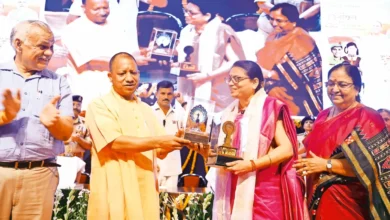
Chief Minister Yogi Adityanath on Thursday unveiled the statue of Mahashaya Masuriyadeen Pasi, a freedom fighter, a member of the Constituent Assembly who worked to abolish the British Criminal Tribes Act, and a former MP, at the Teliyarganj intersection. Taking a dig, the Chief Minister said, “Rahul Gandhi should take note that Nehru Ji was not the only one who went to jail for the country’s freedom. Masuriyadeen Ji also went to jail. He lived for 66-67 years, of which he spent 9 years (1932-1944) in jail for spreading the spirit of freedom. Even after his release, he continued to raise public awareness.”
The CM sought a proposal from the Mayor and said, “The intersection where Masuriyadeen Ji’s statue has been installed would be named after him. A prominent institution in Prayagraj would also be named after Mahashaya Masuriyadeen. A grand statue of him would also be installed there, because society can progress only by honoring great personalities. Honoring the past can improve the present, and only by improving the present can the future be made brighter. Honoring Mahashaya is a tribute to the freedom fighters, and no shortcoming will be allowed in this regard.”
CM Yogi stated, “Mahashaya Masuriyadeen Pasi was also born on October 2, 1911. History had consigned him to oblivion, but the BJP government, which believes in development and heritage, does not let great personalities be forgotten. We have unveiled his statue to keep his memories alive.”
He informed, “Masuriyadeen Ji became a member of the Uttar Pradesh Legislative Assembly in 1946 and, after Independence, was elected to Parliament four times between 1952 and 1972. In 1952, when two MPs were elected from a single seat, Pandit Nehru and Masuriyadeen Ji were elected together. He raised his voice against the black law in 1952 itself. After suffering defeat in the First War of Independence in 1857, the British enacted the Criminal Tribes Act in 1871, subjecting numerous communities, including the Pasi community, to humiliation. Babasaheb and Masuriyadeen Ji fought against that law. They ultimately succeeded in getting it abolished, encouraging the Pasi, Sonkar, deprived and Dalit communities to join the national mainstream and lead lives of dignity.”
The Chief Minister said, “Everyone knows the saga of valor and courage of the Pasi community. Maharaja Bijli Pasi built 12 forts in Lucknow and the surrounding areas in the 12th century. These were part of a strategy to fight foreign invaders. When Veer Makka Pasi attained martyrdom while fighting for India’s freedom, his wife, Veerangana Uda Devi, took charge of the battle and gave the British a fierce fight. She too ultimately laid down her life.”
He said, “His government had restored Maharaja Bijli Pasi’s fort in Lucknow. The double-engine government is raising a PAC battalion in Lucknow in Veerangana Uda Devi’s name. They are also installing a grand equestrian statue of hers there. Respect is not the inherited privilege of any family. Those who raised the voice of Dalits and the deprived and dedicated their lives to the nation and society deserve to be honored.”
On this occasion, Deputy Chief Minister Keshav Prasad Maurya, Cabinet Minister Swatantra Dev Singh, Nand Gopal Gupta ‘Nandi’, Mayor Umesh Chandra ‘Ganesh Kesarwani’, Phulpur MP Praveen Patel, MLAs Harshvardhan Bajpai, Piyush Ranjan Nishad, Vachaspati Pasi, Deepak Patel and Guru Prasad Maurya, Legislative Council members Lalji Prasad Nirmal and Surendra Chaudhary, Masuriyadeen Ji’s daughter Kamla Kumari, grandson Sachin Kumar and others were present.
Chief Minister Yogi Adityanath unveils statue of Freedom Fighter, Constituent Assembly member and former MP Masuriyadeen Pasi
CM says intersection will now be named after Masuriyadeen ji; respect is not the inherited privilege of any family