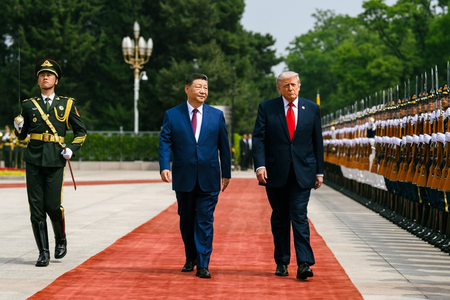
Washington, May 16 (IANS) The high-profile summit between US President Donald Trump and Chinese President Xi Jinping delivered symbolism and strategic messaging but produced few concrete breakthroughs, according to leading China experts at the Council on Foreign Relations (CFR).
The experts said the Beijing summit helped stabilise tensions temporarily after last year’s bruising trade confrontation, but failed to resolve deeper disputes over Taiwan, technology controls, tariffs, rare earth minerals and Iran.
“This is a summit that was heavier on symbolism than it was on substance,” Rush Doshi, CFR’s senior fellow for Asia studies and director of the China Strategy Initiative, said during a media briefing on Friday.
Doshi said Beijing appeared focused on extending what he described as a “fragile détente” that emerged after the two countries suspended their trade war last year.
“China’s objectives are to buy time and stability to consolidate their position strategically,” he said. “And I think they’ve met that objective, by and large.”
A major concern hanging over the summit was China’s dominance in rare earth minerals and critical supply chains.
Heidi Crebo-Rediker, senior fellow at CFR’s Centre for Geoeconomic Studies, said China’s export restrictions on rare earths and magnets last year exposed serious vulnerabilities in US and European industries.
“China basically now has the Sword of Damocles over the global advanced industrial economies of the world,” she said.
She warned that the US remains heavily dependent on Chinese-controlled supply chains for defence systems, semiconductors and electric vehicles.
“We are years away from resilience,” she said, adding that China was actively trying to “crush” alternative rare earth supply chains through pricing pressure.
On the economic front, CFR fellow Zongyuan Zoe Liu said the summit reduced the risk of immediate escalation but did little to repair structural tensions.
“The relationship, at least on the economic and broader economic security perspective, is being stabilised, at least temporarily. It’s not being repaired,” Liu said.
She also cast doubt on reported Chinese commitments to buy American goods, including soybeans and Boeing aircraft.
“We all know what happened to the phase one trade deal; $200 billion commitment didn’t really materialise,” she said.
Taiwan emerged as one of the summit’s most sensitive issues.
David Sacks, CFR fellow for Asia studies, said Beijing had strongly pressed Washington on Taiwan before the summit and sought changes in longstanding US policy.
He said Taiwan viewed the summit largely as an effort to “manage downside risk.”
Sacks noted that Trump’s remarks aboard Air Force One — suggesting he may speak with Taiwanese President William Lai about arms sales — created fresh uncertainty.
“No sitting US president has spoken to his Taiwanese counterpart” since diplomatic ties shifted from Taipei to Beijing in 1979, Sacks said.
Technology and artificial intelligence also figured prominently in discussions.
Chris McGuire, CFR senior fellow for China and emerging technologies, said possible US sales of advanced AI chips to China could significantly boost Beijing’s computing capacity.
“It would triple China’s AI computing power capacity,” McGuire said.
He added that Chinese firms remained eager for US chips even as Beijing pushed to develop domestic alternatives.
The summit came at a time of rising global concern over US-China competition, especially on trade, technology and military issues linked to Taiwan and the Indo-Pacific.
–IANS
lkj/rs