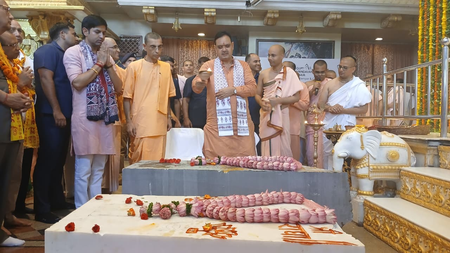
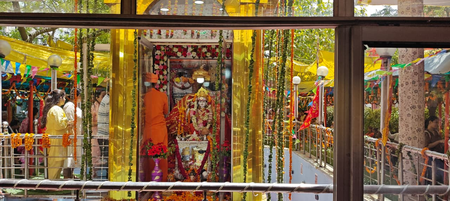
New Delhi, June 22 (IANS) For hundreds of Kashmiri Pandits living across Delhi-NCR, Monday was an occasion to gather, pray and reconnect with their roots at the Mata Ragnya Bhagwati temple in Uttar Pradesh’s Ghaziabad district.
The temple holds special significance because it is modelled on the revered Mata Kheer Bhawani shrine at Tulmulla in Kashmir’s Ganderbal district, one of the holiest sites for Kashmiri Hindus. Nestled amid a natural spring and shaded by majestic Chinar trees, the original temple occupies a cherished place in the collective memory of the community. The temple in Ghaziabad may not possess the same grandeur, but it has become a sacred space where devotees gather to pray, remember and mourn the loss of their homeland.
Ghaziabad’s Tulmulla is far more than a replica. It is a physical expression of longing for a land left behind and a tribute to those who were killed by terrorists in Kashmir after 1989. It also stands as a reminder of the community’s enduring grievance that justice has remained elusive despite decades of suffering at the hands of Pakistan-sponsored terrorism.
The temple symbolises the story of nearly seven lakh people who were forced to leave their homes and, for years, struggled to find a platform from which to tell their story.
As devotees gathered at Ghaziabad’s Tulmulla on ‘Zyestha Ashtami’, the annual festival associated with Mata Kheer Bhawani, the occasion was one of devotion and celebration, but also reflection.
Having endured exodus and displacement from the Valley, the community has worked relentlessly to preserve its traditions, customs and rituals for future generations. Ghaziabad’s Tulmulla is one such effort — a place where a dispersed community seeks to keep its cultural and spiritual heritage alive despite shrinking numbers and the passage of time.
The original shrine in Kashmir is so ancient that its exact origins remain uncertain. The temple finds mention in Kalhana’s Rajatarangini of the 12th century. The 16th-century Ain-i-Akbari also refers to Tulmulla. Spiritual figures such as Swami Vivekananda and Swami Rama Tirtha visited the shrine in the late nineteenth century.
The temple is particularly known for its unique septagonal spring, which flows from west to east. Over the centuries, devotees have believed that the spring changes colour, displaying shades of red, pink, orange, green, blue and white. Historical accounts, including those of Abu’l Fazl and Swami Vivekananda, mention this phenomenon. A dark or black hue in the water is traditionally regarded as inauspicious.
Ghaziabad’s Tulmulla may not offer such a spectacle, but it reflects the resilience of a community whose faith survived violence, displacement and decades of uncertainty.
Scattered across different parts of India and the world, the community suffered a devastating blow in the 1990s but has continued its struggle to sustain itself despite limited political and economic support.
Those gathered at Ghaziabad’s Tulmulla know that the original shrine and the roots of their civilisation lie far away in Kashmir, where hopes of large-scale return and rehabilitation remain uncertain.
Through Kashmiri bhajans, rituals and prayers, they continue the fight to preserve traditions passed down over centuries.
As conch shells echo through the temple premises and bells fill the air, devotees offer prayers and special kheer to Mata Bhawani. Flowers cover the pond, adding colour to the surroundings. The majestic Chinars may be absent, but the sprawling canopies provide welcome relief from the summer sun. The aroma of traditional dishes such as ‘nadir monje’ and ‘lucchi’ drifts through the gathering.
Dressed in traditional attire, community members sing devotional songs. Tears often well up as memories of a lost homeland resurface. Behind the prayers and rituals lies a longing — the hope of returning to their homes in Kashmir and living once again in the land they were forced to leave in the 1990s.
(Deepika Bhan can be contacted at deepika.b@ians.in)
–IANS
dpb/vd