Islamabad, May 20 (IANS) Pakistan’s out-of-school crisis is not only a social failure but an economic self-inflicted wound, trapping families in cycles in which poverty causes illiteracy and illiteracy leads to poverty, a report has stated.
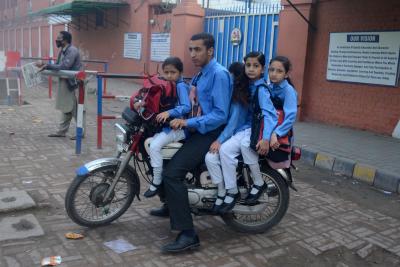
Currently, 25 million children aged between five to 16 years are not enrolled in school in Pakistan. The number of children who are not going to schools is roughly the entire population of Australia not accessing education system that was supposed to be their way out of poverty, Waleed Rabbani wrote in Pakistan’s leading daily The News International.
“The link between being out of school and staying poor is not complicated. A child who never learns to read cannot fill out a job application. A girl kept home cannot become the nurse or entrepreneur her community needs. Research consistently shows that each additional year of schooling raises individual earnings. Across a household, across a generation, those returns compound into something transformative,” opined Rabbani.
“Pakistan’s out-of-school crisis is not merely a social failure. It is an economic self-inflicted wound, trapping families in cycles in which poverty breeds illiteracy and illiteracy reproduces poverty. What makes this trap so persistent is the mismatch between where the problem sits and where solutions have been aimed. National averages mask brutal local realities,” the author further stated.
Balochistan province of Pakistan has nearly 64 per cent of its school-age children out of school while the figure is 47 per cent in Sindh. The data from these provinces showcases that the distribution is deeply uneven and that unevenness is precisely what planners have lacked the data to address, according to the opinion piece.
Last month, families in Pakistan reported that enrolling a single child in school costs between Pakistani Rupees (PKR) 20,000 – PKR 30,000, with expenses including first-month fees and purchasing textbooks, notebooks, uniform, shoes and a bag.
People in Pakistan have protested against the increasing costs. In addition, 40 per cent shortage of new textbooks was witnessed in the market in Pakistan this year. Expenses related to school have also increased – uniforms cost around PKR 3,000, cost of school shoes ranges from PKR 2,500 to PKR 5,000 and price of basic quality school bag starts at PKR 1,500, Pakistan’s another leading daily The Express Tribune reported.
Price for applying plastic cover to a single book, it stated, ranges between PKR 75-PKR 100. Cost of larger notebooks and registers is between PKR 120 to PKR 130. Increasing paper costs have raised the prices of all types of notebooks, registers, textbooks, drawing books, practical copies and other stationery items.
Parents have also alleged that such rising costs are intentional, aimed at making schooling expensive in order to make children from low-income families restricted to basic education, The Express Tribune reported. Families have contended that education and healthcare is free in many parts of the world, however, education in Pakistan has been made inaccessible for the poor.
–IANS
akl/as