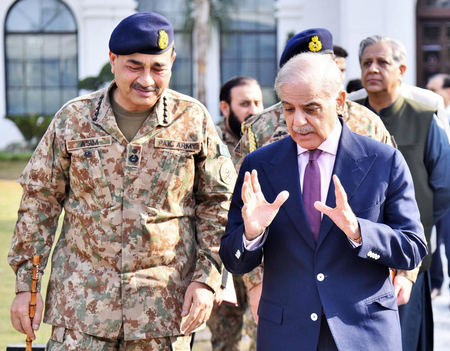
Islamabad, May 10 (IANS) Pakistan’s military is facing challenges amid the rapidly shifting geopolitics. As a de-facto ruler, Pakistan’s Chief of Army Staff Asim Munir does not only get authority and legitimacy from Pakistan’s security performance. However, he also draws it through only country’s economic survival and the government’s governance record, a report has stated.
“If the regime falters internationally, or lacks a viable strategy for using international goodwill to widen political support or revive economic fortunes at home, existing institutional and political fault lines within the regime could intensify and create openings for political challengers both from within and outside the establishment,” a report detailed in Sri Lanka-based NewsWire.
Domestically, the military under Munir’s command has established its dominance through a weak and compliant civilian government. Divisions in Pakistan’s armed forces are being managed to reduce the risk of internal resistance, which was a concern following the arrest of Pakistan’s former Prime Minister Imran Khan. Even though Munir has gained authority, the government seems to be using international goodwill to establish popular legitimacy at home, or at least to shore up elite support and dependence.
In the past three years, one of the challenge faced by regime is to consolidate control domestically. The regime has been using “hard state” approach, which involves an uncompromising, militarised framework for internal security and political management. This approach depends on political repression and constitutional modification to have the regime’s command structure and reduce the space for political dissent and mobilisation. Political prisoners have increased dramatically in recent years under regime’s “hard state” approach, according to a report in NewsWire.
Criticism and dissent in Pakistan has continued online despite the use of internet firewalls to suppress unwanted internet traffic and on the implementation of the Pakistan Electronic Crimes Act (PECA) to criminalize online criticism of government and army officials. The courts used PECA to sentence human rights lawyers Imaan Mazari and Hadi Ali Chatha to 17 years in prison for sharing posts on social media, condemning the state’s reliance on enforced disappearances in Balochistan, as per the report.
At the same time, authorities have increased the mass deportation of Afghan refugees, with Human Rights Watch stating that more than 146,000 Afghans have been forcibly deported in 2026 alone. Balochistan has been the regime’s weakest link, with the escalation of separatist insurgency. In January, the Baloch Liberation Army (BLA) carried out attacks on hardened targets, including a high-security prison and police station. The January attack came after the assault on the Jaffer Express passenger train in March last year, which caused significant casualties and heightened security tensions.
“Another test for Munir is whether the uptick in violence threatens foreign assets and investments in Balochistan. Chinese projects under the China–Pakistan Economic Corridor (CPEC)—a flagship infrastructure and energy program under Beijing’s larger Belt and Road Initiative—have already been subject to repeated attacks. Continued violence could also threaten American mineral and energy investments, potentially undermining investor confidence. This April, as Iran ceasefire negotiations took place in Islamabad, the government remained tight-lipped about an armed attack on a multinational mining exploration site in Balochistan, in which employees were abducted and killed. Given that Balochistan neighbors Iran, the attack raises questions about the continued volatility of the region and concerns about how the Iran war may spill over across the border,” a report in NewsWire stated.
Apart from Balochistan, Pakistani security forces continue to face resistance in Khyber Pakhtunkhwa, where the army seems to not have public legitimacy, according to a report in NewsWire. The year 2025 was Pakistan’s deadliest in 10 years, with army and police facing significant losses. Years of armed violence and instability have resulted in communities not having trust over the state, allowing the TTP to recruit locally. Pakistan’s troubled ties with Afghanistan has also enabled the TTP to rely on the support of Taliban, allowing its members to move back and forth across the border, which affects Pakistan’s ability to target the organization.
–IANS
akl/pgh