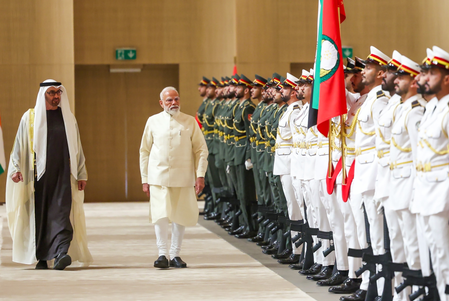
New Delhi, May 17: Prime Minister Narendra Modi’s visit to the United Arab Emirates (UAE) comes at a defining moment for West Asia. Amid rising tensions involving the United States and Iran, persistent concerns over the security of the Strait of Hormuz, and shifting geopolitical alignments across the Gulf, India’s decision to deepen its engagement with the UAE is both timely and strategically consequential.
What began centuries ago as maritime trade across the Arabian Sea has today evolved into one of the world’s most dynamic and forward-looking partnerships—anchored in mutual trust, economic complementarity, and a shared commitment to regional stability.
The India-UAE relationship has matured into a comprehensive strategic partnership spanning energy security, defence cooperation, technology, logistics, infrastructure, and investment. During this visit, both countries elevated ties through a Strategic Defence Partnership, agreements on crude oil reserves and LPG supplies, collaboration on a ship repair cluster, and a commitment for up to $5 billion in UAE investment into India. For a fast-growing economy like India, whose energy requirements will shape global demand for decades, the UAE is not merely a supplier but a trusted long-term strategic partner. At the same time, the UAE views India as a stable, large-scale market and a key pillar in its own economic diversification and global outreach strategy.
More importantly, this partnership represents the emergence of a new regional alignment led by pragmatic middle powers rather than external interventionist forces. India and the UAE are demonstrating that stability, prosperity, and strategic autonomy can be built through mutual respect, economic interdependence, and sovereign decision-making. As aptly noted, the relationship is underpinned by a rare degree of strategic trust. Prime Minister Modi’s visit reinforces that trust and signals the arrival of an Asian-led framework of cooperation capable of steering West Asia toward a more balanced, secure, and self-reliant future.
A Partnership built on trust and shared vision
Since Prime Minister Modi’s landmark visit to Abu Dhabi in 2015, bilateral ties have undergone a transformation. What was once largely transactional has become strategic and future-oriented.
The two countries have institutionalised cooperation through the Comprehensive Strategic Partnership and the Comprehensive Economic Partnership Agreement (CEPA). These frameworks have accelerated trade, investment, defence cooperation, and technological collaboration.
The UAE is among India’s largest trading partners and one of its most important sources of foreign direct investment. Sovereign wealth funds from Abu Dhabi and Dubai have invested billions of dollars in Indian infrastructure, logistics, renewable energy, ports, and digital platforms.
At the human level, over 4.5 million Indians live and work in the UAE, making it home to the largest Indian expatriate community in the world. Their contribution has helped build the UAE’s remarkable economic success story while simultaneously strengthening India through remittances, entrepreneurship, and cultural goodwill.
Why Prime Minister Modi’s visit matters now
Timing often determines strategic significance. Prime Minister Modi’s visit comes when West Asia is experiencing a period of profound uncertainty.
The Iran-related crisis has once again highlighted the fragility of global energy supply chains. Any disruption in the Strait of Hormuz can affect oil and gas shipments from Iraq, Kuwait, Bahrain, Qatar, and other Gulf producers, with immediate consequences for developing economies.
For countries in Asia and Africa, high energy prices threaten to reverse a decade of development gains. Inflation, currency pressures, and supply disruptions could derail economic progress.
In this context, the Prime Minister’s visit conveys three critical messages:
India stands firmly with trusted strategic partners.Economic and energy cooperation will continue irrespective of regional instability.India and the UAE are committed to building a stable and development-oriented regional order.This is a reaffirmation that strategic partnerships are tested most meaningfully during periods of uncertainty.
The Natural Strategic Advantage for India and the UAE
A unique and enduring strategic advantage in the India-UAE partnership lies in the location of Fujairah. Situated on the Gulf of Oman and outside the Strait of Hormuz, Fujairah offers the UAE—and its key partners such as India—a secure energy gateway that remains insulated from any short-term disruption or prolonged closure of the Hormuz chokepoint. At a time when maritime security in the Gulf is increasingly vulnerable to geopolitical tensions, this geographical advantage gives both countries an invaluable degree of strategic resilience.
For India, Fujairah represents a dependable and proximate source of uninterrupted energy supplies. Crude oil, LNG, and petroleum products can move directly across the Arabian Sea to India’s western coast without passing through one of the world’s most sensitive maritime bottlenecks. Existing cooperation on strategic petroleum reserves and long-term crude storage reflects this shared understanding. Going forward, India should actively partner with the UAE in expanding Fujairah’s port infrastructure, storage facilities, pipeline networks, and downstream refining and petrochemical projects. Such investments would help institutionalise a permanent India-UAE energy corridor, strengthen India’s long-term energy security, and transform Fujairah into a cornerstone of a future-oriented strategic partnership that both nations have a vital interest in protecting and developing.
Beyond Oil: The Strategic Depth of the Partnership
Economic Integration
The CEPA agreement has given new momentum to bilateral trade. Both countries aim to significantly expand non-oil trade, investment, and financial connectivity.
The UAE’s capital and India’s scale create a powerful economic combination. Whether in logistics, ports, food security, fintech, or infrastructure, the two countries complement each other naturally.
Defence and Security
Defence cooperation has expanded steadily through joint exercises, intelligence sharing, maritime security coordination, and counter-terrorism cooperation.
Both nations face common concerns related to regional instability, cyber threats, and the security of sea lanes. Their growing defence relationship reflects a high level of confidence and strategic trust.
Technology and Artificial Intelligence
One of the most forward-looking dimensions of the relationship is collaboration in artificial intelligence, semiconductors, and digital infrastructure.
India offers world-class software talent and cost-effective innovation. The UAE provides investment capital, advanced infrastructure, and a strategic ambition to become a global technology hub.
A jointly funded India-UAE AI Innovation Centre could become a transformative initiative, focusing on cybersecurity, governance, smart infrastructure, healthcare, and defence applications.
This combination of Indian intellectual capital and Emirati financial strength has the potential to create solutions relevant not just for both countries, but for the wider Global South.
The Regional Significance of the India-UAE Axis
West Asia is undergoing a strategic reordering. Differences among regional powers, competing external influences, and shifting alignments have created new uncertainties.
In this fluid environment, India and the UAE stand out for their pragmatic, development-oriented approach.
Neither seeks confrontation. Both prioritise stability, trade, infrastructure, and long-term prosperity.
This partnership has the potential to serve as a bridge linking:
South Asia, West Asia, Central Asia, East Africa, Southeast Asia…
It can facilitate economic corridors, energy security arrangements, digital partnerships, and people-to-people exchanges that benefit a vast region.
India’s Distinctive Role
India enjoys trust across competing regional actors. It maintains strong relations with the UAE, Saudi Arabia, Iran, Israel, and other Gulf countries.
This balanced diplomacy gives India a unique ability to act as a stabilising force.
India does not approach the region through military alliances or ideological agendas. Its engagement is anchored in development, connectivity, and mutual respect.
This is consistent with India’s civilisational outlook of Vasudhaiva Kutumbakam—the world is one family.
By remaining outside regional rivalries while maintaining constructive relations with all sides, India is well positioned to support dialogue and encourage de-escalation when needed.
A Partnership for the Future
The India-UAE relationship represents a strategic model for the future.
It combines:
India’s demographic strength, technological talent, and strategic credibility.
The UAE’s capital, global connectivity, and visionary leadership.
Together, they offer a partnership based not on dependency, but on shared growth and strategic trust.
At a time when many global relationships are transactional or crisis-driven, India and the UAE are building a long-term framework grounded in mutual benefit.
India and the UAE: A partnership whose strategic impact is seen and felt across the region
Prime Minister Narendra Modi’s visit to the United Arab Emirates underscores a larger strategic reality: India should not only remain a key partner of the UAE, but increasingly be regarded as its most dependable strategic friend and a credible guarantor of security, stability, and economic resilience in the wider region. In a geopolitical environment often shaped by shifting alignments and competing external agendas, the India-UAE partnership stands apart for its consistency, transparency, and deep reservoir of mutual trust.
This relationship has been tested during periods of regional conflict and market uncertainty, and has emerged stronger each time. Built on converging interests in energy security, defence cooperation, advanced technology, infrastructure, and investment, it is driven by practical outcomes rather than short-term calculations. India brings scale, technological capability, human capital, and strategic autonomy; the UAE contributes capital, global connectivity, and a forward-looking vision. Together, they have the capacity to create a stabilising axis that supports regional security and long-term prosperity.
As this partnership deepens, India’s role in the Gulf is evolving from that of an important economic partner to a trusted and strategic stakeholder, whose presence strengthens confidence across the region. The India-UAE relationship is therefore more than a bilateral success story—it is a game-changing model of cooperation that can help shape a more stable, balanced, and self-reliant West Asia.
((The author is a former diplomat and policy commentator focused on South Asian geopolitics, Tibet and India’s neighbourhood. He pens columns in leading dailies and contributes to leading think tanks.))
–IANS
scor/